Why Outboards Die Suddenly After Running Fine
Outboard troubleshooting has gotten complicated with all the generic “check everything” advice flying around. You search for answers, find a 47-step carburetor rebuild guide, and your actual problem was an $8 rubber bulb the whole time.
As someone who has limped back to the dock more times than I’d like to admit, I learned everything there is to know about sudden outboard death the expensive way. Today, I will share it all with you.
Here’s what makes this failure pattern so maddening: the engine shows zero distress signals before it quits. No sputtering. No smoke. No warning light. Just dead weight hanging off your transom — and then, twenty minutes later, it starts right back up like nothing happened.
Most repair guides treat this as one generic failure. It isn’t. When it dies matters enormously. Dies after five minutes of running? Completely different animal than dying after twenty minutes under load. The timing, the temperature, the throttle position when it cuts out — those details point directly to the cause. So, without further ado, let’s dive in.
This guide focuses on three culprits that almost nobody mentions: fuel primer bulb collapse, vapor lock, and kill switch lanyard corrosion. These are the sneaky ones. No warning lights. No obvious damage. They just kill the engine, let it cool, and allow you to run again — until the pattern repeats two hours later.
Check the Fuel System First — Primer Bulb and Vent
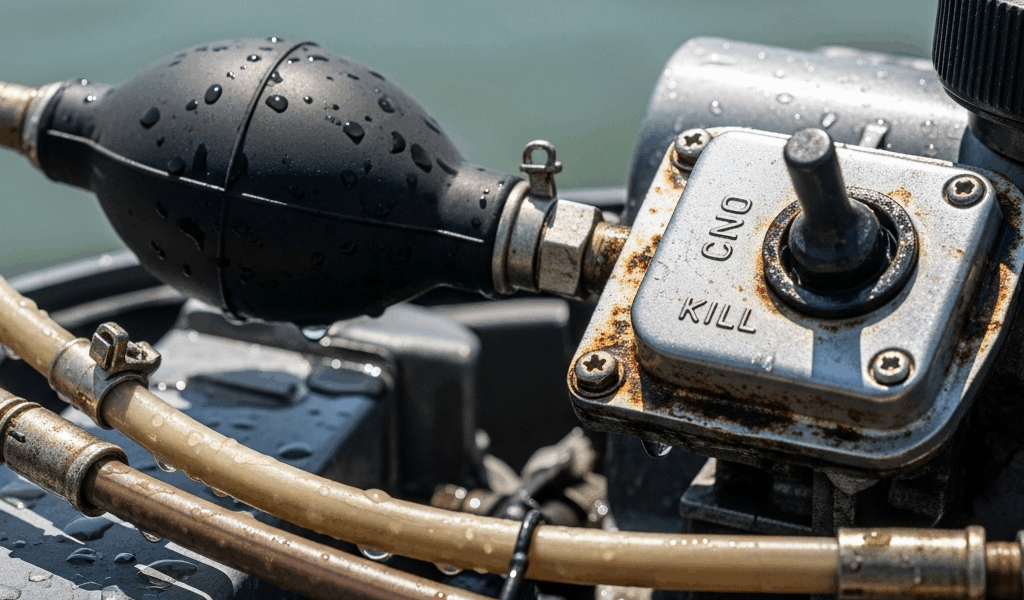
Start with the simplest test possible. Find your fuel primer bulb — the palm-sized rubber bulb sitting somewhere between your tank and the engine, usually bright red or occasionally white. Squeeze it firmly.
It should be solid. Springy. Resistant.
Mushy is bad. If it collapses without real resistance or takes three seconds to rebound, it’s failed internally. A collapsed primer bulb can’t sustain fuel pressure to the carburetor, so the engine starves even though fuel is technically sitting right there in the tank. Replacement costs maybe $8 to $15 for an aftermarket Attwood or Sierra bulb — probably the cheapest repair in all of marine mechanics.
While you’ve got the fuel system exposed, check the fuel tank vent. It’s the small cap or valve on top of your tank — easy to overlook, easy to forget exists. A clogged vent creates a vacuum inside the tank. The engine consumes fuel, pressure drops, and eventually nothing pulls through the line. Engine dies. You sit on the water for ten or fifteen minutes, atmospheric pressure equalizes through whatever gap it can find, and the engine starts again. Repeat all day long.
Probably should have opened with this section, honestly. I spent two full hours cleaning a carburetor that didn’t need touching — a Mikuni on an older 40-horse Yamaha — before discovering the vent was half-plugged with algae. Two hours. For a blocked vent. Don’t make my mistake. Take the cap off and hold it up toward sunlight. You should see clear daylight straight through. Opaque or blocked means a shot of compressed air or a thin piece of wire to clear it.
Last fuel check: crack open the fuel cap and smell inside the tank. Water-contaminated fuel has a distinctly sour, almost vinegary smell. Visible separation — a clear layer pooling beneath colored fuel — confirms it. The engine burns through the good fuel sitting on top, hits the water layer underneath, and quits instantly. Drain the tank completely, flush it, and refill with fresh 87 or 89 octane plus a dose of Sta-Bil Marine formula. That’s the one with the blue label.
Vapor Lock and Heat Soak — The Warm Weather Trap
Vapor lock is the forgotten diagnosis in outboard repair. But what is vapor lock? In essence, it’s fuel boiling inside the supply line before it reaches the engine. But it’s much more than that — it’s also one of the most consistent misdiagnoses in recreational boating.
Classic pattern: engine runs perfectly for fifteen to twenty-five minutes. The hull warms up, the fuel line bakes in direct July sun, the temperature inside that black rubber hose climbs past 120 degrees. Suddenly, dead. You wait fifteen minutes in the boat, the fuel cools and re-liquefies, you restart, and everything works beautifully — for another twenty minutes. That’s what makes vapor lock endearing to us shade-tree mechanics: it solves itself, which means most people never actually fix it.
Confirm vapor lock by noting restart behavior. No fuel pressure gauge needed. If the engine fires immediately after sitting idle for ten minutes — no cranking issues, just instant restart — vapor lock is signaling you. An engine with ignition failure or a mechanical problem won’t restart that cleanly.
The fix is physical. Wrap your fuel line in reflective foam fuel line insulation — the same stuff used on lawn equipment and small engines. About $6 to $12 for a roll at any hardware store. Wrap it tightly from the tank connection all the way to the engine. You can also position the fuel tank in a shaded compartment if your boat allows it.
I’m apparently a worst-case-scenario boater and the wrap-plus-shade combination works for me while nothing else ever really stuck. Some people run their fuel hose through a small cooler with ice on brutal August days. Unconventional, yes. Effective, also yes. Most practical long-term fix though: back off the throttle slightly during hot conditions. Vapor lock almost never occurs at trolling speed — only sustained cruising generates enough heat to cause it.
Kill Switch Lanyard and Ignition Issues
The kill switch is a famous failure point that disguises itself convincingly as a fuel problem. That’s what makes kill switch corrosion endearing to us frustrated boaters — it looks like everything else.
Frustrated by what seems like a carburetor issue, most people tear into the fuel system using carburetor cleaner, rebuild kits, and three hours of bench time. This new focus on ignition eventually evolved into the diagnostic approach serious outboard mechanics know and trust today. Start at the lanyard.
The connector where the lanyard plugs into the switch corrodes — salt spray, moisture, vibration cycles across a full season. After two or three years, that connection becomes intermittent. Engine runs. A wave hits, the motor vibrates, micro-disconnect happens. Engine dies. Connection remakes. You restart. It seems completely random because technically nothing is broken — just corroded enough to lose contact under specific vibration frequencies.
Test it yourself. Remove the lanyard clip entirely. Take two short pieces of wire and bridge the connector terminals — you’re manually closing the kill switch circuit, bypassing the lanyard entirely. Run the engine that way for twenty minutes. If it runs without cutting out, the lanyard connector is your problem. Replace the entire kill switch assembly. Usually $30 to $50 depending on the motor year and brand. Mercury assemblies tend to run toward $45, older Johnsons closer to $30.
While you won’t need a full ignition analyzer, you will need a handful of basic tools for the next step. Ignition coil failure is worth checking — specifically on engines that die after twenty to thirty minutes of sustained running and won’t restart until they’ve cooled for at least fifteen minutes. A multimeter can measure coil resistance. Specs vary by manufacturer, but most outboard coils measure between 0.05 and 0.5 ohms on the primary winding. Outside that range means the coil is failing under heat. A replacement coil typically runs $60 to $120 and usually solves it cleanly.
Quick-Reference Diagnosis Chart by When It Dies
Dies in under 5 minutes: Check the primer bulb first — squeeze test for mushiness and slow rebound. Then inspect the fuel tank vent for blockage. Water contamination in the tank is also a strong candidate. Start here before touching anything else.
Dies after 15 to 25 minutes of steady running: Vapor lock or kill switch intermittent contact. Wrap the fuel line in reflective insulation first, since it costs $8 and takes ten minutes. Then test the lanyard connector by removing it and jumping the circuit with two short wires.
Dies suddenly under heavy load: Fuel pump output drops under demand. The carburetor fuel inlet needle may be stuck partially closed. These require slightly more involved troubleshooting — but they almost always point to internal fuel system wear rather than ignition.
Dies then restarts cleanly after cooling: Ignition coil or stator heat failure. That was the coil on a 1998 Evinrude 50 I chased for an entire season before finally pulling the trigger on a $75 replacement. Runs perfectly now. Spark disappears as components reach operating temperature, returns once they cool. New coil needed.
First, you should work from fuel system toward ignition — at least if you want to catch the most common failures without spending money on parts you don’t need. Test the primer bulb. Check the vent. Confirm fuel quality. Test the kill switch lanyard. That sequence catches roughly ninety percent of sudden-death cases before you ever open the cowling. If you’ve worked through all of it and the engine still dies on you, take it to a mechanic. You’ve already done the baseline diagnostics, which means the shop spends less time guessing and charges you for actual repair work instead of investigation time.



Stay in the loop
Get the latest maritimematterstoday updates delivered to your inbox.