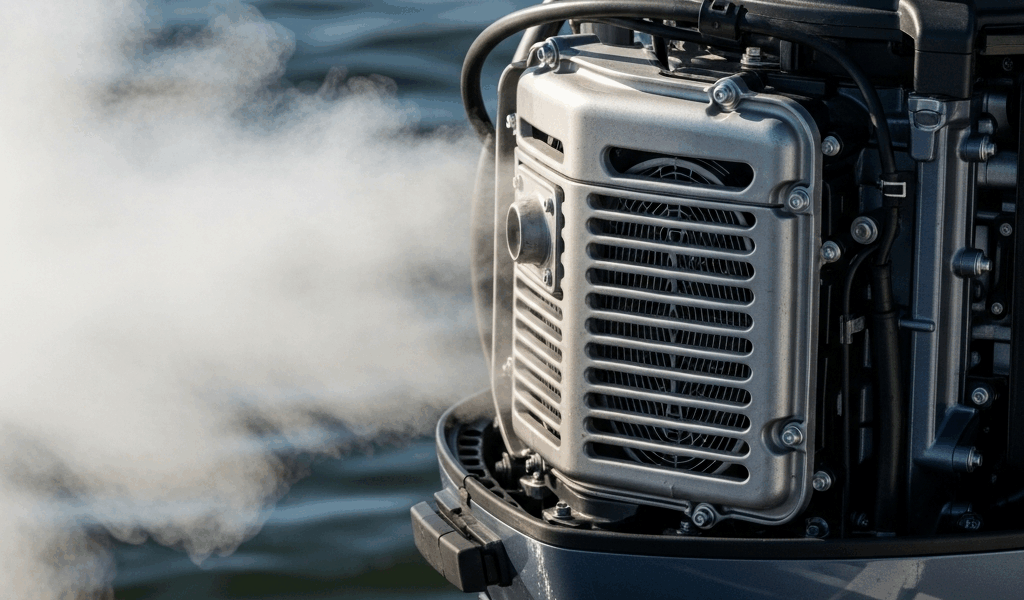
White Smoke from Your Outboard — What It Usually Means
Outboard smoke diagnosis has gotten complicated with all the conflicting advice flying around online. So let me cut through it. I spent a Saturday morning last summer watching my 2008 Mercury 90hp billow white smoke like an old steam locomotive the moment I pulled away from the dock. Stomach-dropping moment. I was already mentally calculating repair bills — seized pistons, cracked block, the full catastrophe. Turned out I was mostly wrong. Today, I’ll share everything I learned so you don’t spiral the way I did.
But what is white smoke, exactly? In essence, it’s your engine telling you something entered the combustion chamber that shouldn’t be there — or it’s nothing at all. But it’s much more than that simple explanation, because the difference between “nothing” and “stop the engine right now” comes down almost entirely to timing and smell.
Cold-start white smoke clears in roughly 60 seconds. Smells like wet laundry, nothing alarming. That’s condensation burning off cylinder walls — totally normal, especially on two-strokes. I’ve never once seen a boater need a mechanic for this. Watch it disappear and move on with your morning.
Persistent white smoke is the different animal. Two to three minutes of continuous smoke after startup, or smoke that appears on a fully warmed engine — that’s water entering the combustion chamber. Here’s the tell: a faintly sweet odor, almost like maple syrup left on a hot pan. That’s coolant burning. Blown head gaskets produce that smell distinctly. Cracked blocks do too, though they’re genuinely rare on modern motors.
Pull your dipstick immediately if the smoke isn’t clearing. Wipe it, reinsert, pull again — proper reading technique matters here. Milky, foamy oil, the consistency of chocolate milk, confirms coolant mixing with oil. That’s your answer. Stop running the motor. Not after you reach the dock. Now.
Blue Smoke from Your Outboard and Why It Matters
Blue smoke means oil burning inside the combustion chamber. Not coolant — oil. And the diagnostic path splits hard depending on whether you’re running a two-stroke or four-stroke. That distinction matters enormously here.
On four-stroke outboards — Yamahas, newer Mercurys, Tohatsu four-strokes — blue smoke usually means worn piston rings or degraded valve seals. Piston rings seal combustion pressure inside each cylinder. Wear them down and oil creeps past, gets burned, and exits as blue smoke. Valve seals fail the same way from the other direction. Both are internal wear issues. Both require disassembly to fix properly.
Two-strokes are a different conversation entirely. Frustrated by mysterious blue smoke on a borrowed 2003 Yamaha 25hp, I finally traced it back to an embarrassingly simple cause: wrong fuel mix ratio. I used old mixing instructions — had been running 50:1 instead of the required 100:1. Smoked like a paper mill the entire afternoon. Two-strokes burn oil mixed directly into fuel for lubrication; they have no separate oil reservoir. Get that ratio wrong and blue smoke follows immediately. Don’t make my mistake — check your owner’s manual every single time, not your memory.
Here’s a practical field test worth knowing. Accelerate hard from idle and watch the exhaust. A sharp blue puff on throttle-up is diagnostic in two directions — it tells you under-load conditions are exposing the problem, and it narrows down whether you’re looking at ring wear on a four-stroke or a rich mix on a two-stroke. Worn rings tend to smoke more under load specifically because compression demands spike. Rich fuel mix smokes more consistently, but hard acceleration makes it obvious fast.
Light blue on cold start only, clears in under a minute? That’s often overnight oil residue burning off. Monitor it next month. Dark blue, thick, persistent at cruise? That needs attention before end of season — at least if you want the motor to survive into next year.
Step by Step — How to Diagnose the Smoke Yourself
Skip the guessing. Observe systematically and the answer usually surfaces fast.
- Note the exact color first — white, blue, or gray. Gray typically signals a combination of both problems, which is worse. Take a photo if you can. Your mechanic will thank you.
- Note when the smoke appears. Cold start only? Under acceleration? Sitting at idle? Steady cruise throttle? Timing is the whole diagnosis here.
- Check oil level and condition. On four-strokes, use the dipstick. On two-strokes, verify your fuel mix ratio against the owner’s manual — not the internet, the actual manual. Mercury 90hp models from 2006 onward specify 50:1; older two-stroke Mercurys often ran 100:1. Assuming is how mistakes happen.
- Inspect the oil itself on four-strokes. Healthy oil looks amber or light brown. Milky oil means water contamination. Black oil just means an overdue oil change — it probably isn’t causing your smoke, but it’s still worth noting.
- Run the motor and watch for 3-5 minutes. Does white smoke linger past the 60-second mark? Does blue smoke visibly thicken when you push the throttle? Write it down before you forget the details.
After those five steps, you can sort yourself into one of these buckets:
- White smoke persists past 2 minutes + milky oil on dipstick: Stop running immediately. Head gasket failure or block damage is the likely diagnosis.
- White smoke clears within 60 seconds + clean oil: Normal condensation. Run it and monitor the next startup.
- Blue smoke on cold start only, clears fast: Likely oil residue burning off. Check again next month before worrying.
- Blue smoke thick or showing up at cruise speed: Piston ring wear on a four-stroke, or fuel mix problem on a two-stroke. Call a mechanic within the season — at least if you want to avoid the worse version of this repair.
- Gray smoke: Combination issue. Professional diagnosis, probably sooner than you’d like.
Which Smoke Colors Mean Stop the Engine Immediately
Probably should have opened with this section, honestly. Persistent white smoke plus milky oil is a stop-now situation — not a finish-the-fishing-trip situation. A failed head gasket means coolant is entering your combustion chamber. Running on that actively destroys the engine in real time.
Coolant washes the lubricating oil film off your piston rings and cylinder walls. Metal contacts metal. Heat spikes. The gasket failure accelerates under load because pressure inside the cylinder increases with RPMs. You can turn a $1,400 head gasket repair into a $4,000 engine replacement inside a single afternoon on the water. A friend of mine did exactly that — ignored white smoke all day because the boat was still running. It wasn’t running by sunset. Expensive lesson I watched happen firsthand.
Blue smoke alone almost never demands an immediate shutdown. Oil burning is a genuine problem, but it’s a slow one. You typically have a season to address it before internal damage becomes severe. That said — don’t file it away and forget it either.
When to Fix It Yourself vs. Call a Marine Mechanic
Fuel mix errors on two-strokes are 100% DIY territory. Drain the tank, refill with correctly measured mix at your manual’s specified ratio, run the motor for 15 minutes at moderate throttle. Problem solved, assuming that was the cause. Cost is essentially zero beyond the fuel itself.
Head gasket replacement is not DIY for most people — at least not without a proper workshop. You’re looking at complete powerhead disassembly, torque specifications that have zero margin for error, specialized tools including a torque wrench calibrated in inch-pounds, and precise realignment during reassembly. Marine mechanics in most regions charge $150–$250 per hour. A head gasket job on a 90hp outboard runs 8–15 hours of labor depending on the specific motor. Budget $1,200–$3,500 total including parts. Smaller motors come in cheaper. Larger ones go higher.
Piston ring replacement on a four-stroke sits in that same DIY-unfriendly category. Internal engine work demands precision equipment and experience most recreational boaters simply don’t have on hand.
Prevention beats all of this. I’m apparently sensitive to oil brand differences — Yamaha Genuine 2M outboard oil works perfectly for my motors while off-brand substitutes never quite behave the same way. Runs about $28–$38 per liter, but it’s the right call for cylinder protection. For two-strokes, a proper fuel ratio measuring bottle costs around $12–$15 at West Marine and removes all the guesswork. Flush your cooling system with fresh water after every saltwater outing — corrosion inside water passages is what eventually causes head gasket failures on motors that otherwise had no business failing. Make that flush a non-negotiable part of every trip home.



Stay in the loop
Get the latest maritimematterstoday updates delivered to your inbox.