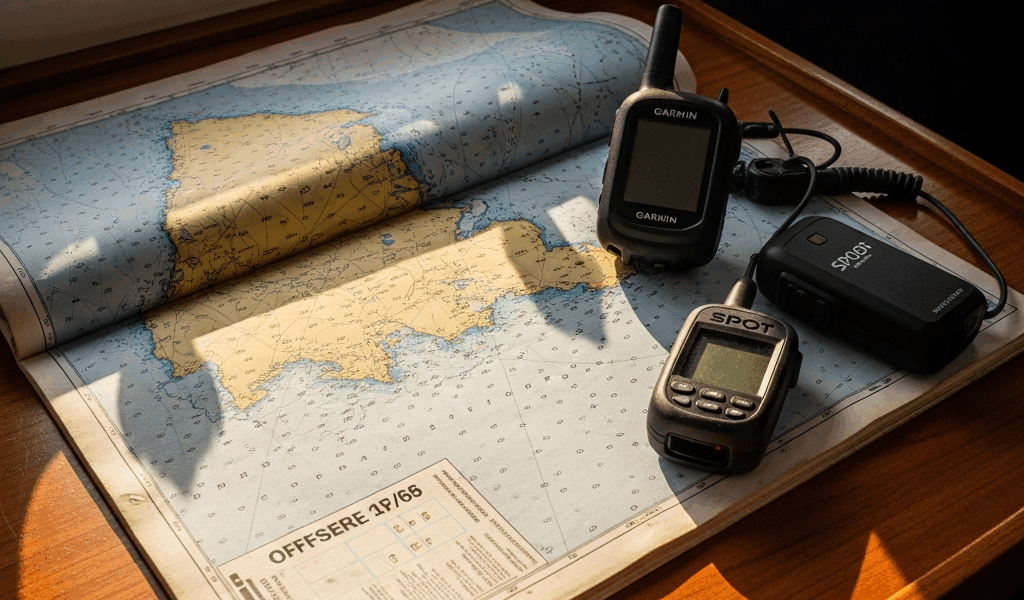
Best Satellite Communicator for Boating — Garmin inReach vs SPOT vs Zoleo
Satellite communicators for boating have gotten complicated with all the hiking-focused reviews flying around. As someone who has run a 28-foot center console offshore in the Gulf of Mexico for eight years, I learned everything there is to know about which of these devices actually hold up when the coast disappears behind you. The Garmin inReach Mini 2 is currently bolted next to my chartplotter. Before that I ran a SPOT Gen4 for two seasons. I tested the Zoleo for four months on coastal trips before I’d trust my opinion on it. So when I say these devices perform differently on the water than they do on a trail, that’s not speculation — it’s three devices, eight years, and a few genuinely uncomfortable situations offshore.
Hikers want something light that fits in a chest pocket. Boaters want two-way communication, real marine weather overlays, a path to the Coast Guard, and something that won’t die the second a wave breaks over the console. Different problems entirely. The device that wins a backpacking comparison doesn’t automatically win here.
Why Boaters Need Different Features Than Hikers
The offshore environment changes the calculus on almost every spec that matters. Cell coverage disappears fast — depending on your coast and your carrier, you’re often out of signal by 10 to 15 miles. After that, your VHF is your primary voice tool, but it won’t text your spouse, pull a NOAA forecast, or ping the Coast Guard with your GPS coordinates. That’s the gap satellite communicators fill.
Here’s what actually matters on the water, ranked by how much it’s bitten me in real situations:
- SOS with GPS relay to the Coast Guard — Every device on this list has an SOS button. What varies is whether the monitoring center has a documented protocol for coordinating with USCG and whether your coordinates update in real time while you’re drifting. Not trivial when conditions are moving.
- Two-way messaging — One-way tracking is fine for a day hike. Offshore, you want confirmation that someone received your message — and the ability to get a response back with updated weather or an ETA change.
- Marine weather data — Not a generic forecast. Actual marine weather: wind speed at sea level, wave heights, marine-layer conditions. The Garmin inReach integrates with the Garmin Explore app and pulls NOAA marine forecasts. SPOT cannot do this at all.
- Network coverage offshore — This one surprised me when I first started researching it. The SPOT Gen4 runs on the Globalstar network, which has documented dead zones in parts of the Pacific, the South Atlantic, and some offshore Gulf routes. Garmin inReach and Zoleo both run on Iridium — 66 low-earth-orbit satellites, true global coverage, including both poles.
- Mounting options and water resistance — You need IP67 or better if it’s living on the helm. You also need something that can actually be mounted, not just tucked into a pocket.
I learned the mounting lesson the hard way. Don’t make my mistake. My first season with the SPOT, I kept it in a Pelican case in the console — seemed reasonable. Then I needed to trigger my track log and couldn’t reach it fast enough when things got rough 22 miles out near the Chandeleur Islands. After that I bought a RAM mount and bolted it to the T-top support with a knob-style ball joint. Changed everything about how useful the device actually was.
Garmin inReach Mini 2 — The Best All-Around for Boaters
Probably should have opened with this section, honestly. If you want one answer and don’t want to read the whole comparison — get the Garmin inReach Mini 2.
But what is the inReach Mini 2, really? In essence, it’s a two-way satellite messenger that runs on Iridium and integrates with Garmin’s navigation ecosystem. But it’s much more than that — especially for boaters who need marine-specific weather data and a device that actually talks back.
The Mini 2 retails around $349.99. It’s 3.5 inches tall, weighs 100 grams, and carries an IPX7 water resistance rating — submersible to 1 meter for 30 minutes. That’s not the same as being wave-proof, but I’ve had spray hit it hundreds of times and it has never failed. Not once.
Frustrated by a near-miss situation 40 miles off the Louisiana coast in 2021, I finally understood why two-way messaging matters. We had a mechanical issue — not distress exactly, but we needed to reach someone on shore and get an update on the weather window that was closing behind us. My VHF reached another boater who relayed through Coast Guard, but with the inReach I could have messaged my marina contact directly and gotten an actual response. I didn’t have the inReach then. I had the SPOT. I sent a tracking point. Nobody could respond. That’s a lonely feeling 40 miles out with a raw water pump acting up.
The Mini 2 gives you full two-way SMS and email messaging through the Garmin Explore app via Bluetooth pairing. The physical buttons let you send preset messages without your phone — useful when your phone is dead or soaked. SOS connects to GEOS, Garmin’s 24/7 monitoring center, and they handle USCG coordination with your live GPS track updating throughout the rescue process.
Weather is where inReach really separates itself for boaters. Through the Garmin Explore app, you can request a marine weather forecast for your specific coordinates — NOAA-sourced wind and sea state data delivered via satellite when you have no other option. I’ve used this 35 miles out when my VHF weather broadcast was cutting in and out. It works.
Subscription plans start at $14.95/month for the Safety plan — SOS and tracking, limited messaging. The Recreation plan is $34.95/month with 40 messages included. Expedition runs $64.95/month with unlimited messaging. Most weekend boaters do fine on Recreation. Live-aboards or anyone doing extended offshore passages should look at Expedition and not think twice about it.
SPOT Gen4 — Budget Option with Real Limitations
The SPOT Gen4 costs about $149.99. Base subscription runs around $11.95/month. That price point is the whole decision for a lot of people, and honestly, I understand it.
Here’s what you actually give up. SPOT is one-way only — you can send an “OK” message to pre-set contacts, broadcast your GPS track, and trigger SOS. That’s the entire list. Nobody can respond to you. You cannot request weather data. You cannot send a custom text. You are essentially a beacon that tells people where you are and whether you’re okay. That’s it.
The Globalstar network issue is real and documented. Coverage is solid along the continental US coastline, in the Caribbean, and in well-trafficked offshore areas. But head to the Bahamas, the Pacific, or any blue-water passage outside North American coastal waters and you will find gaps. Globalstar publishes their coverage map and it’s honest about the limitations — check it against your actual routes before you buy anything.
For day trips on coastal waters, staying within 30 miles of shore, primarily wanting an SOS backup — the SPOT Gen4 is functional. The SOS system connects to GEOS, same monitoring center Garmin uses, so that part is solid. But I would not take it offshore. I did, and I felt it every time conditions shifted and I couldn’t do anything except send another “OK” ping and hope my wife figured out I was fine. That’s what makes two-way communication endearing to us offshore boaters — it’s not a luxury, it’s just basic communication that the SPOT doesn’t offer.
Zoleo — Best for Messaging-Heavy Users
The Zoleo costs $199 and runs on Iridium — same network as the inReach Mini 2, so coverage is equivalent. Global, reliable, no meaningful dead zones anywhere you’re likely to take a recreational vessel. Subscription starts at $20/month for the basic plan: unlimited SOS, 25 messages, one weather check per day. The $35/month plan gives you unlimited messaging.
What Zoleo does better than inReach is the messaging interface. The app is cleaner, the keyboard integration feels more natural, and conversations thread properly — it actually feels like a texting app rather than a satellite radio log. If your primary use case is staying in contact with people on shore — crew families, your marina, a float plan contact — and you’re exchanging real back-and-forth conversations rather than status pings, Zoleo is the better experience.
The device itself is flat and puck-shaped, about 3.3 inches across. IPX7 rated. It pairs via Bluetooth and uses your phone as the main interface, similar to the inReach. It does not have the physical button simplicity of the inReach for sending preset messages without a phone — which matters if your phone battery dies somewhere off the Dry Tortugas at dusk.
Where it falls short for dedicated offshore boating is weather data. Zoleo offers one basic weather check per day on the base plan — a generic coordinate forecast, not marine-specific wind and sea state data the way inReach pulls NOAA marine forecasts. For coastal cruisers in familiar waters with solid pre-trip planning, that’s probably fine. For offshore use where conditions change fast and you need actionable marine data on demand, inReach wins that category without much argument.
Monthly Plan Comparison
Here’s where the real decision often lands. Device cost is a one-time hit. Subscriptions are forever — or at least for every season you’re on the water.
| Device | Device Cost | Base Monthly Plan | Messages Included | Per-Message Fee (overage) | SOS Included | Estimated First-Year Cost |
|---|---|---|---|---|---|---|
| Garmin inReach Mini 2 | $349.99 | $34.95/mo (Recreation) | 40 messages | $0.50/message | Yes | ~$770 |
| SPOT Gen4 | $149.99 | $11.95/mo (Basic) | Unlimited tracking, no two-way | N/A (no messaging) | Yes | ~$294 |
| Zoleo | $199.00 | $20.00/mo (Basic) | 25 messages | $0.50/message | Yes | ~$439 |
The first-year cost estimates above assume 12 months of active subscription at base plan rates. Many boaters suspend their subscription in the off-season — Garmin and Zoleo both allow this. SPOT’s terms are more restrictive depending on which plan you’re on, so read the fine print before assuming you can pause. If you’re a seasonal boater running May through October, six months of the Garmin Recreation plan is $209.70. Add the device and you’re at roughly $560 for your first season — still more than SPOT, but the gap narrows considerably.
The SPOT’s price advantage is real and significant. The capability gap is also real. Paying $476 more in year one for the inReach Mini 2 gets you two-way messaging, marine weather data, and Iridium global coverage. Whether that math works depends entirely on where you boat and how far offshore you actually go.
My Actual Recommendation
Coastal boater, day trips, stays within 20 miles of shore, primarily wants an SOS backup — start with the SPOT Gen4. You’ll upgrade when the limitations frustrate you, and they will eventually. Probably faster than you expect.
Offshore boater, regularly goes beyond cell coverage, wants actual communication capability rather than just an emergency button — buy the Garmin inReach Mini 2. Get the Recreation plan at minimum, Expedition if you’re doing anything serious. It’s the right tool, and the price difference stops feeling significant fast when you’re 50 miles out and the weather is doing something unexpected.
Coastal cruiser doing longer passages who values clean messaging over weather integration — Zoleo might be the best option, as extended passage-making requires consistent communication with people ashore. That is because the Iridium coverage eliminates the gaps that knock SPOT out of contention, and the messaging interface is genuinely better for actual conversations rather than status updates.
All three will connect you to rescue services in an emergency — that baseline matters and all three deliver it. But on the water, the difference between a device that only works when everything goes wrong and one that actively keeps you informed and connected throughout a trip is the difference between a safety tool and an actual piece of seamanship equipment. First, you should decide which one you actually need — at least if you’re being honest about where you boat and how far offshore you’re willing to go without real communication.



Stay in the loop
Get the latest maritimematterstoday updates delivered to your inbox.