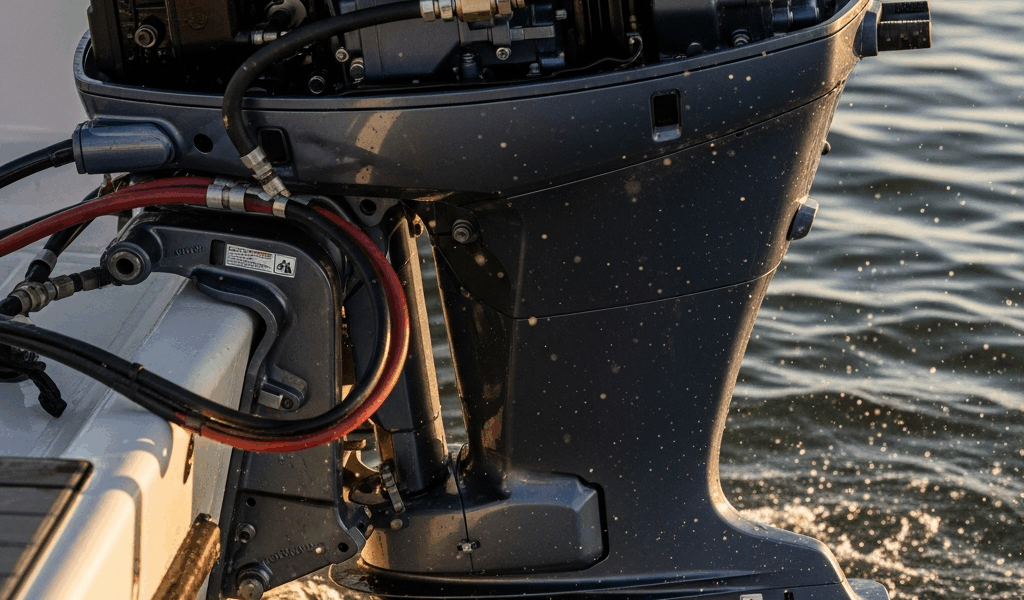
Why Outboards Sputter at Full Throttle
Outboard troubleshooting has gotten complicated with all the forum noise flying around. As someone who’s logged way too many hours on the water — and even more in a garage that smells permanently of two-stroke oil — I learned everything there is to know about wide-open throttle sputtering. Today, I will share it all with you.
Here’s the one fact your diagnosis has to start with: WOT is brutal. Maximum fuel demand. Peak heat. Ignition timing pushed to its limit. Any weakness hiding in your fuel or spark system will absolutely surface the moment you push that throttle all the way forward — even if the engine sounds perfectly fine at cruise.
That sputtering you’re hearing? Almost never a rod knock. Almost never catastrophic. It’s your engine begging for fuel or spark consistency. And sputtering only under load is fundamentally different from rough idle. That distinction alone cuts your diagnostic list in half.
Fuel Starvation Is the Most Common Cause
Start here. Roughly 70% of WOT sputtering issues trace back to fuel starvation. That’s not a guess — that’s just what the pattern looks like after years of chasing these problems.
The Primer Bulb Test — Do This First
Frustrated by a sputter I couldn’t explain, I ran a test at the dock one afternoon using nothing but the rubber primer bulb on my fuel line. While the engine was screaming at full throttle and stumbling, I squeezed the bulb firmly. The sputtering cleared for about eight seconds. That was it — fuel starvation confirmed.
If squeezing the bulb buys you even 5–10 seconds of clean running, your fuel pump is weak or something downstream is blocking flow. This single test saves hours of guessing. Do it before you touch anything else.
Clogged Fuel Filter
But what is a fuel filter doing to cause this? In essence, it’s catching sediment before it reaches the pump — but it’s much more than that. A clogged filter becomes a flow restrictor, and at WOT your engine needs every drop it can get.
Most outboard filters are 10-micron or 20-micron cartridges tucked near the fuel pump — easy to miss if you’ve never gone looking. I learned this the hard way after inheriting a 2003 Yamaha F150 with what turned out to be the original factory filter. Don’t make my mistake. Pull it, hold it up to light, and if it isn’t translucent, replace it. OEM filters run $12–$35. A swap takes maybe 15 minutes.
Failing Fuel Pump
The diaphragm inside your fuel pump degrades over time. When it starts to fail — not completely, just partially — fuel volume drops right when WOT demands the most. Back the throttle off and the sputtering eases up, because demand drops.
Fuel pumps sit on the engine block. Most replacements run $40–$150 depending on brand and model. You’re disconnecting fuel lines and pulling a handful of bolts. If the primer bulb test showed improvement and the filter is clean, plan on replacing the pump next.
Kinked or Pinched Fuel Line
Walk the entire fuel line. Tank to engine. Every inch. I once found a line pressed completely flat between two stainless steel clamps — nobody had noticed because it only fully collapsed under the sustained pull of WOT. That was a $22 hose causing a diagnosis that almost ended in a carburetor rebuild.
Replace any damaged section immediately. Marine-grade fuel line runs $15–$30 per foot. Use hose rated for your engine’s fuel pressure — typically 3–6 PSI on carbureted motors. The fittings and clamps matter just as much as the hose itself.
Vented Fuel Cap Creating Vacuum Lock
There’s a small vent hole in your fuel cap. If it clogs — debris, old gunk, years of neglect — the tank can’t breathe as fuel drains. Pressure drops. The pump fights itself. Fuel delivery collapses right at WOT when draw is highest.
Pull the cap off, find the vent hole, and blow compressed air through it. Takes 30 seconds. If it’s permanently blocked or cracked, replacement caps are $20–$40. This is especially common on older motors or any tank that sat through a long off-season.
Dirty or Failing Fuel Injectors and Carb Issues
Probably should have opened with carb cleanliness earlier in my boating life — would have saved me one very long Saturday. This is the second most likely culprit, and it’s worth understanding before you reach for a wrench.
Carbureted Motors — Clogged Main Jet
A carbureted outboard leans out hard at WOT. If the main jet — the primary fuel metering orifice inside the carb — picks up any varnish or sediment, flow drops exactly when your engine needs it most. The result is sputtering, hesitation, or a four-cylinder that starts sounding like a two-cylinder somewhere around 4,500 RPM.
Before pulling anything apart, try Seafoam or Chevron Techron. One can into a half-tank, then run the engine at cruise and moderate throttle for about 20 minutes. Light varnish dissolves. Plenty of boaters skip straight to carb removal — which runs 3–4 hours — and then feel ridiculous when cleaner would have fixed it.
If cleaner doesn’t help, pull the carb (usually 6–8 bolts), disassemble it, and soak the jets overnight in carburetor cleaner. The main jet is the largest orifice in there. Use compressed air to clear it. Never a wire — you’ll enlarge the orifice and create a rich condition that’s almost as annoying as the original problem.
EFI Motors — Dirty Injectors and Low Fuel Pressure
Fuel-injected outboards are more forgiving than carbs — until they aren’t. Ethanol residue and old fuel leave deposits on injector pintle seats. The result is a lean misfire at WOT that feels identical to a spark problem.
A fuel pressure gauge ($50–$100 for a decent one) should show 30–50 PSI at idle and hold steady under load. If pressure drops when you push it, the pump is going. If pressure holds but injectors are still suspect, Redline or BG fuel system cleaner are the go-to choices — they cost more than generic carb cleaner, but they actually reach injector internals.
Ignition Problems That Show Up Under Load
Spark plugs and ignition coils take real punishment at WOT. A plug that fires cleanly at 1,500 RPM can misfire completely at 5,500 RPM when combustion chamber heat and compression both spike simultaneously. That’s what makes ignition diagnosis endearing to us shade-tree mechanics — it only misbehaves when you can least afford to stop and check.
Worn Spark Plugs
Pull all the plugs and look at the center electrode. Factory gap specs typically land between 0.030 and 0.040 inches, but a worn plug has a rounded, pitted electrode that’s visually obvious once you compare it to a new one side by side.
Replace plugs as a complete matched set — never one at a time. Mixing old and new creates uneven firing across cylinders, which makes the sputtering worse, not better. OEM plugs for most outboards run $8–$15 each. I’m apparently sensitive to plug brand and NGK works for me while Champion never quite did, but either beats running worn electrodes another season.
Fouled Plugs and Carbon Buildup
A fouled plug looks black and wet or packed with dry soot. It tells you fuel is entering the cylinder but not burning — often because ignition timing has drifted or the gap has opened too wide. You can clean fouled plugs with a wire brush, but honestly, just replace them. They’re $8–$15 each. It’s not the battle worth fighting.
Failing Ignition Coils
Coils degrade quietly over years of use. A coil producing enough spark at cruise RPMs can fall short at WOT when demand spikes. Most outboards run one coil per cylinder or a single coil pack. Swap a suspected coil between cylinders — if the misfire follows it to the new position, it’s failing.
OEM coils run $40–$120 each. Aftermarket options exist for less but have a mixed reliability record. If one coil is going, the others are probably aging at the same rate. Replace them together.
Propeller Cavitation and Ventilation Can Mimic Sputtering
Not every sputter is an engine problem. So, without further ado, let’s dive into the mechanical side — because prop issues create RPM surges that feel exactly like ignition misfires from the helm.
Cavitation — Damaged or Bent Propeller
Run your fingers along every blade face. Feel for nicks, dents, or any rough edges along the leading surface. Even a small ding disrupts water flow and creates cavitation bubbles — the engine RPMs surge briefly, and from the helm it’s indistinguishable from a cylinder missing.
A damaged prop needs replacement. Depending on type and brand, expect $150–$400. That’s not cheap, but running a damaged prop stresses the entire drivetrain.
Ventilation — Incorrect Jack Plate Setting
If your jack plate is set too high, the prop breaks the water surface under load. Air enters the hub instead of water. RPMs surge violently and uncontrollably — it looks and feels like severe sputtering. Back the jack plate down and it disappears completely. That’s your answer if everything else checks out clean.
Your Diagnostic Checklist
- Squeeze the primer bulb at full throttle. Sputtering clears briefly? Diagnose fuel starvation.
- Inspect and replace the fuel filter — especially if you don’t know when it was last changed.
- Trace the full fuel line for kinks, cracks, or pinch points.
- Verify the fuel cap vent hole is clear. Blow compressed air through it.
- Test or replace the fuel pump if steps 1–4 don’t resolve it.
- For carbureted motors, add Seafoam or Techron before pulling the carb.
- For EFI motors, use quality EFI cleaner and check fuel pressure under load.
- Pull and inspect all spark plugs. Replace as a complete matched set.
- Swap or replace ignition coils if new plugs don’t fix the misfire.
- Inspect the propeller for blade damage and verify jack plate height is correct.
Most WOT sputtering clears somewhere between steps 1 and 5. That’s it. You’ll skip a $400+ marina diagnostic bill and actually understand what your engine was telling you. Start with fuel. Move to ignition. Then check the prop. That order works every time.




Stay in the loop
Get the latest maritimematterstoday updates delivered to your inbox.