Trolling Motor Battery Guide — Lithium vs AGM vs Lead Acid for 2026
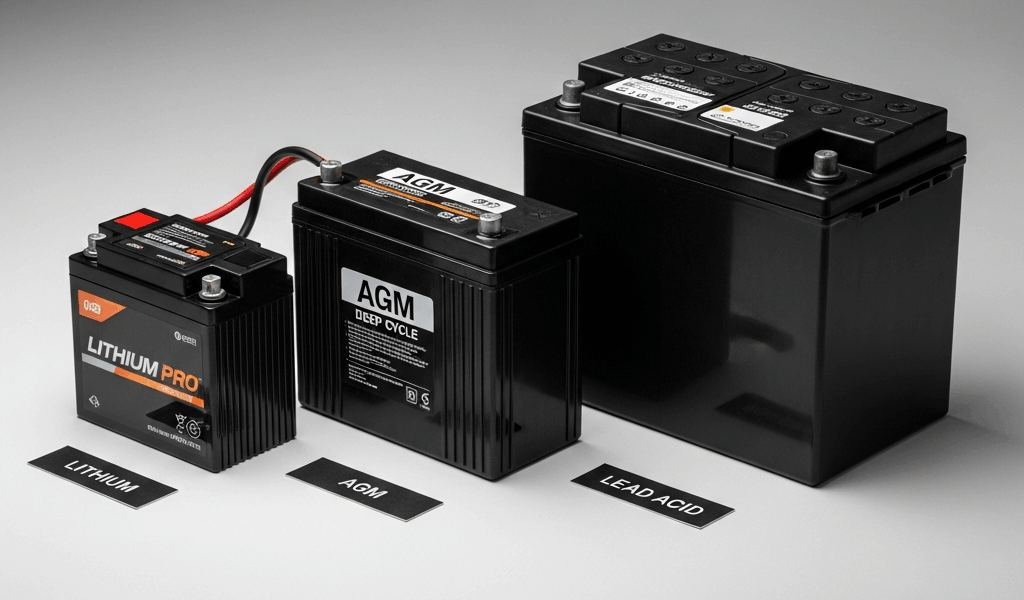
The best trolling motor battery decision — lithium vs AGM vs lead acid — is one I got wrong twice before I finally got it right. I’ve run all three types across five seasons on the same 18-foot bass boat, and the differences between them are not subtle. They affect how long you stay on the water, how much you’re hauling in and out of your truck, and whether you’re cutting a trip short at 2 PM because your motor is dragging through the last hour. This guide gives you what I wish I’d had: real numbers, real cost comparisons, and honest recommendations without the manufacturer cheerleading.
Lithium vs AGM vs Lead Acid — Quick Decision Table
Before anything else, here’s the side-by-side. These numbers are based on published specs and what I’ve personally verified across my own batteries and talking with other anglers at my local ramp.
| Feature | Flooded Lead Acid | AGM | Lithium (LiFePO4) |
|---|---|---|---|
| Typical Weight (100Ah) | ~63 lbs | ~60 lbs | ~25 lbs |
| Usable Capacity | ~50% (50Ah usable) | ~60–70% (60–70Ah usable) | ~95–100% (95–100Ah usable) |
| Cycle Life | 200–400 cycles | 400–600 cycles | 2,000–5,000 cycles |
| Upfront Cost (100Ah) | $90–$140 | $180–$260 | $400–$900 |
| Maintenance Required | Yes — water, equalization | Minimal | None |
| Self-Discharge (monthly) | ~15–25% | ~3–5% | ~1–3% |
| Cold Weather Performance | Poor | Moderate | Good (avoid charging below 32°F) |
The usable capacity column is the one most people miss. A flooded lead acid battery rated at 100Ah doesn’t give you 100Ah. Drain it below 50% regularly and you’ll kill it in a season. Lithium gives you nearly the full rated capacity on every discharge. That means a 100Ah lithium battery genuinely replaces a 150–200Ah lead acid setup in practice.
When Lithium Is Worth the Price
Probably should have opened with this section, honestly — because the upfront price of lithium is the reason most people talk themselves out of it and end up buying a third AGM instead.
Here’s the math I actually ran before I pulled the trigger on a Dakota Lithium 100Ah last spring.
Cost-Per-Season Breakdown Over 5 Years
Assume you fish 60 days a season — weekends, a few weekday evenings, maybe a tournament or two. That’s roughly 300 cycles over 5 years at that pace.
- Flooded lead acid (Interstate DCM0100, ~$110): Max 300–400 cycles if treated well. Realistically, at 60 trips per year, you’re replacing it every 2–3 seasons. Over 5 years: 2 batteries = $220. But factor in a maintenance charger ($40–$60), watering costs, and the reality that most people don’t maintain them perfectly — real 5-year cost is closer to $320–$380.
- AGM (VMAXTANKS MX105, ~$220): Better cycle life, but still 400–600 cycles. One battery might cover 5 years if you treat it right. Add a compatible smart charger ($60–$80). Real 5-year cost: $280–$330.
- Lithium (Dakota Lithium 100Ah, ~$595 at time of writing): Rated at 2,000+ cycles with an 11-year warranty. At 60 trips per year, you will not wear this battery out in 5 years. Period. No maintenance charger needed. No water checks. 5-year cost: $595 flat, possibly with a charger upgrade of ~$80. Total: ~$675.
The break-even point is roughly year 4 if you’re an active angler. If you fish fewer than 30 days a season, the math shifts. Lead acid and AGM start looking reasonable again when the cycle count difference doesn’t materialize for 10+ years. But if you’re on the water constantly, lithium pays for itself — and then some — before your warranty expires.
The mistake I made was buying a cheap flooded battery two years in a row, then a mid-range AGM that died in year two because I stored it partially discharged over winter. That’s $400+ in batteries before I ever bought the lithium. Learn from that.
Best Lead Acid Trolling Motor Batteries
Lead acid still makes sense in specific situations — light use, tight budget, or a backup battery you only run a few times a year. Here are the models I’d actually recommend.
Interstate Batteries DCM0100 Deep Cycle Marine
This is the battery sitting in the most bass boats at any given ramp on a Saturday morning, and there’s a reason for that. Interstate’s distribution network means you can find a replacement at a local auto parts store when your old one fails at 6 AM before a tournament. The DCM0100 is a 115-minute reserve capacity battery, runs around $110–$125, and weighs about 63 lbs. It’s not exciting. It works if you maintain it.
- Pros: Widely available, affordable, easy to find locally
- Cons: Heavy, needs maintenance charging, limited usable capacity, dies fast if neglected over winter
Optima BlueTop D31M
This is the step-up flooded option that bridges the gap toward AGM territory. Spiral cell design, better vibration resistance, and a stronger cold cranking performance. Runs about $230–$260. I used one for a full season and was happy with it, but the price puts it in competition with entry-level AGM options that I’d personally choose instead at that price point.
- Pros: Tougher construction, better cycle performance than standard flooded
- Cons: Price overlap with AGM, still heavier than you want long-term
VMAXTANKS MX105 AGM Deep Cycle
Technically an AGM, but worth including here as the best value in the non-lithium category. The MX105 is 105Ah, sealed, and genuinely performs better than any flooded battery I’ve run. Around $220 on Amazon. I ran one for two full seasons before switching to lithium — it never gave me a problem. If you’re not ready to go lithium, this is what you buy.
- Pros: Sealed (no maintenance), solid cycle life, reliable brand with responsive customer service
- Cons: Still heavier than lithium (~60 lbs), usable capacity is still limited to ~70% to preserve battery life
Best Lithium Trolling Motor Batteries
Burned by buying the wrong lithium battery once — a no-name 100Ah from a brand that’s now seemingly disappeared from Amazon — I spent time researching which brands are actually standing behind their products with real warranties.
Dakota Lithium 100Ah
This is the one I currently run and would buy again. Dakota Lithium is a US-based company (Fargo, ND), and their 11-year warranty is the best in the trolling motor battery market. The 100Ah version weighs 26 lbs. Let that sink in — I picked up my entire power setup in one hand. It runs about $549–$595 depending on where you buy it. Performance in cold weather is solid down to about 20°F for discharge (don’t charge below 32°F without a battery heater).
- Pros: Industry-best warranty, US company with real customer support, excellent cold weather performance, drop-in replacement form factor
- Cons: Premium price, need to verify charger compatibility before first use
Ampere Time 100Ah LiFePO4
This is the budget entry point for lithium. Runs about $399–$449 — roughly $150 less than Dakota Lithium. The specs are comparable on paper: 100Ah, LiFePO4 chemistry, built-in BMS protection. The warranty is 5 years, which is shorter than Dakota’s 11 but still reasonable. Several anglers in my fishing club have run these for 2–3 seasons without issues. The build quality is good for the price.
- Pros: Lowest entry cost for quality lithium, solid BMS protection, decent warranty
- Cons: Shorter warranty than competitors, customer service less established
Battle Born 100Ah LiFePO4
Battle Born is the name most overlanders and RV people know, but it crosses over perfectly for trolling motor use. The 100Ah model is built in Nevada, carries a 10-year warranty, and runs about $799–$849. That price is hard to justify versus Dakota Lithium unless you’re buying multiple batteries and want the most proven track record. I know people who’ve had their Battle Borns for 6+ years without a hiccup. If you want the most bulletproof option regardless of price, this is it.
- Pros: Exceptional build quality, 10-year warranty, outstanding long-term reputation
- Cons: Most expensive option in this comparison, harder to justify over Dakota for pure trolling motor use
Charging and Maintenance Differences
This is where a lot of anglers run into trouble — myself included, the first time I switched battery types and didn’t think about charger compatibility.
Lead Acid Maintenance — More Than You Think
Flooded lead acid batteries need water. Specifically, distilled water added to the cells when the level drops below the plates. Ignore this for a few months and you’ll damage cells permanently. They also need equalization charges — a deliberate overcharge that balances cells — every few months. Skip this routine and capacity drops fast. A maintenance charger like the NOCO GENIUS10 ($75) running in the background all winter is essentially required if you want to get through multiple seasons.
AGM batteries skip the watering entirely, but they still benefit from maintenance charging during storage. They’re also sensitive to overcharging — push too much voltage through an AGM and you’ll damage it. Stick to chargers rated specifically for AGM chemistry. Using a standard lead acid charger on an AGM is the fastest way to shorten its life.
Lithium Charging — Different Rules Apply
Lithium batteries don’t need maintenance charging. You can store a fully charged lithium battery for months and come back to it. The self-discharge rate is around 1–3% per month, so a fully charged battery left over winter is still at 85–90% by spring.
The critical issue — and this is where people make expensive mistakes — is charger compatibility. Standard lead acid chargers have a desulfation mode that pushes voltage spikes that can damage lithium battery management systems. You need a charger with a dedicated lithium mode. The NOCO GENIUS5 and GENIUS10 both have lithium modes and are solid options at $44 and $75 respectively. Dakota Lithium also sells their own branded charger for about $99 that I’ve used without issues.
Cold weather charging is the other rule that matters. Charging lithium below 32°F (0°C) can cause lithium plating inside the cells — permanent damage that reduces capacity. Some higher-end lithium batteries have self-heating functions built in. If you fish in early spring or late fall in the northern states, this is worth factoring into your buying decision.
The bottom line across all three battery types: the battery is only as good as how you charge and store it. I’ve killed a perfectly good AGM by leaving it at 20% charge in a cold garage. I’ve also seen flooded batteries last four seasons because one angler kept a NOCO on them all winter without fail. Whatever you buy, match it to a proper charger and you’ll get the full life out of it.




Stay in the loop
Get the latest maritimematterstoday updates delivered to your inbox.