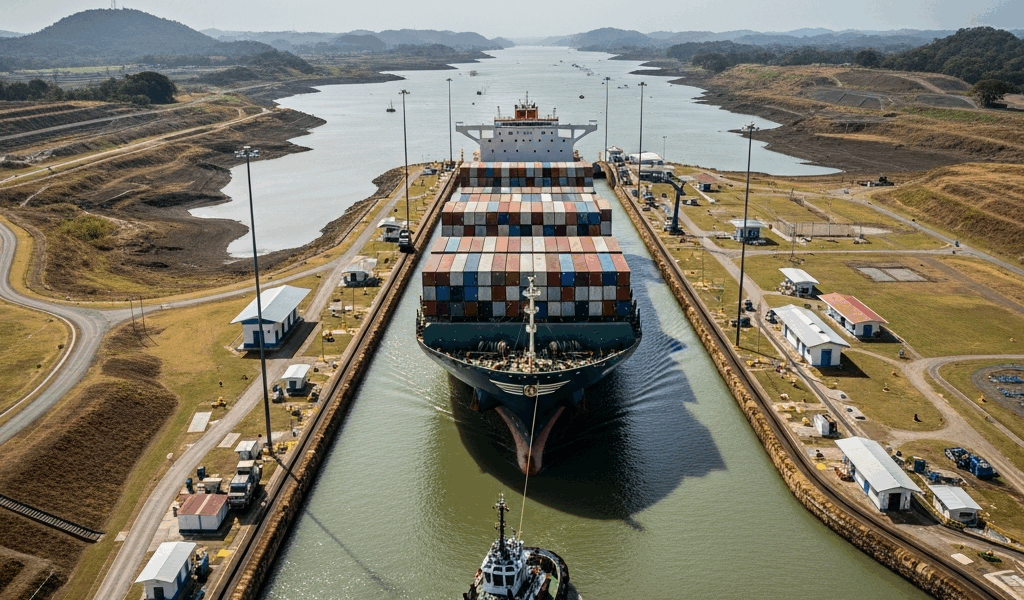
Panama Canal Drought 2026 — What Cruisers and Shippers Need to Know Now
The Panama Canal drought 2026 situation is not a background story anymore. I’ve been covering maritime logistics and cruising routes for going on twelve years, and I haven’t seen this level of operational disruption since the 2021 Suez blockage — and honestly, in some ways this is harder to solve, because you can’t just refloat a drought. The canal is still moving ships, yes. But the story behind the numbers is one that every cruiser with a booking and every importer waiting on container freight needs to understand before they make any plans.
Current Panama Canal Status — March 2026
As of the most recent data published by the Autoridad del Canal de Panamá (ACP), daily transits are running at approximately 24 to 26 vessels per day through the full canal system. Normal operational capacity — what the ACP considers baseline for healthy water levels — sits at 36 to 38 transits daily. That gap matters. A lot.
Gatun Lake, the freshwater reservoir that feeds the entire lock system, is currently sitting at roughly 24.5 meters above sea level. The canal’s operational sweet spot is between 26.5 and 27.2 meters. That might sound like a narrow margin, but each meter of lake depth represents tens of millions of gallons of water needed to cycle ships through the locks. Less water means fewer lock cycles per day. Fewer lock cycles means the queue grows.
Wait Times Right Now
Northbound vessels — those moving from the Pacific to the Atlantic — are currently reporting anchor wait times of 8 to 12 days in the Gulf of Panama. Southbound traffic waiting in Limón Bay on the Caribbean side is seeing similar delays, ranging from 6 to 10 days for vessels without pre-booked slots. Vessels that purchased transit slots through the ACP auction system are moving faster, but those auction prices have been brutal — I’ve seen recent reports of individual slot auctions clearing at $400,000 to $600,000 USD above the standard toll. That’s not a typo.
The ACP has also maintained draft restrictions for the Neopanamax locks at 44 feet, down from the typical operational maximum of around 50 feet. That restriction alone is forcing some of the largest container vessels and LNG tankers to either wait longer for water conditions to improve, lighten their loads, or reroute entirely.
How Does This Compare to Normal
In a standard March — historically one of the drier months, so some reduction in transits is expected — the canal typically runs 30 to 33 transits per day with wait times under 48 hours for most vessel classes. What we’re seeing right now represents roughly a 30 percent reduction in throughput from that benchmark. The 2023-2024 drought was bad. This is tracking slightly worse in terms of lake recovery pace, which I’ll get to in the outlook section.
What This Means for Cruise Passengers
Probably should have opened with this section, honestly — because this is where most of my readers live. If you have a Panama Canal cruise booked for spring or fall 2026, here is what’s actually happening and what you should be doing about it right now.
Several major cruise lines have already quietly adjusted their full-transit itineraries. Holland America, Princess Cruises, and Norwegian Cruise Line have all modified some sailings that were originally scheduled as full ocean-to-ocean transits. The modifications range from partial canal transits — entering the canal, locking through a portion of it, and returning — to complete rerouting that skips the canal entirely and substitutes ports along the Colombian coast or additional Caribbean stops.
Surcharges and What Your Booking Actually Covers
Here’s where I’ve seen passengers get caught off guard, and frankly it’s something I wish I’d flagged louder in my 2024 coverage. The ACP toll increases get passed downstream. Cruise lines are absorbing some of the added cost, but several have added canal surcharges in the $75 to $250 per-passenger range on full-transit bookings. These are showing up in booking documentation as “port charge adjustments” — which is technically accurate and also very easy to miss when you’re scanning a long invoice.
Call your cruise line or travel agent directly and ask two specific questions: Is my sailing confirmed as a full Panama Canal transit? And are there any pending port charge adjustments tied to canal conditions? Get the answers in writing.
Alternative Itineraries Being Offered
Lines offering partial-transit alternatives are generally substituting the partial experience with enhanced time in Cartagena, Colombia, or extending calls at Costa Rica’s Puerto Caldera or Puntarenas. Some passengers actually prefer the substitution. Others booked specifically for the full ocean-to-ocean experience, which is genuinely one of the most remarkable things you can do on a cruise ship — watching a 300-meter vessel rise and fall through the Miraflores locks is hard to replicate with a beach day in Cartagena, no matter how good the arepas are.
If the full transit matters to you, push back. Ask about moving your booking to a later departure where conditions may have improved, or inquire about fare credits if the itinerary changes materially from what you purchased. Most lines have been reasonably accommodating, in my experience, when passengers are specific and persistent about what they booked.
Impact on Global Shipping and Your Wallet
Dragged back into this story by a conversation with a freight logistics contact in Hamburg, I started pulling container shipping data in January and the picture is genuinely complicated. The Panama Canal handles roughly 5 percent of global trade volume and about 46 percent of all container traffic moving between the U.S. East Coast and Asia. When that pipeline slows, the ripple effect is measurable.
Right now, a significant portion of Asia-to-East-Coast container traffic has rerouted through the Suez Canal. The Asia-Europe route via Suez adds approximately 14 to 16 additional sailing days versus Panama routing. That delay has cascading effects on inventory timelines — the kind that show up six to eight weeks later as thinner shelves or longer lead times on imported goods.
What Shippers Are Actually Doing
The rerouting picture isn’t uniform. Here’s roughly how it’s breaking down based on publicly available carrier data and freight index tracking:
- Large container carriers (Maersk, MSC, CMA CGM) have predominantly shifted Asia–U.S. East Coast services to Suez routing for vessels over 12,000 TEU capacity
- Smaller feeder vessels and breakbulk carriers are still using Panama, absorbing wait times and higher tolls as the lesser of two evils compared to the longer Suez routing
- LNG and LPG tankers have been the most affected class — their size relative to draft restrictions makes Panama transits difficult even in normal conditions, and current restrictions are pushing more of them to the Cape of Good Hope routing entirely
- Some U.S. West Coast offload has increased as a partial workaround — goods destined for the Eastern Seaboard arriving at Los Angeles and Long Beach and moving by rail
Consumer Price Impact
Freight rate benchmarks on the Asia–U.S. East Coast lane have climbed roughly 28 to 35 percent compared to this time last year, according to the Freightos Baltic Index. Those increases don’t translate one-to-one to retail prices — retailers absorb some margin, and contract rates buffer spot market spikes — but consumer goods with thin margins and high import dependence are the ones most likely to show visible price creep. Electronics components, apparel from Southeast Asian manufacturers, and certain categories of furniture and home goods are the categories to watch.
It’s not 2021-era supply chain chaos. But it’s not nothing, either.
Will It Get Better — Climate and Infrastructure Outlook
This is the question I keep getting asked. The honest answer requires splitting it into two timelines: 2026 and beyond 2030.
For 2026, the rainfall picture is cautiously improving. NOAA and regional climatological services have shifted from a moderate La Niña pattern — which suppresses precipitation in the Panama watershed — toward neutral ENSO conditions projected through mid-year. The ACP’s own rainfall models suggest a return to closer-to-average precipitation in the May through July rainy season window. If those forecasts hold, Gatun Lake could recover to operational norms by late Q3 2026. The word “could” is doing some heavy lifting there.
The Infrastructure Question
The ACP has been working on longer-term water security for several years. The most significant project is a proposed new water reservoir — a third reservoir system fed by the Indio River — that has been in planning and environmental review since approximately 2019. As of early 2026, it has not broken ground. The political and environmental review process has been protracted, and the ACP’s own timeline now projects the project won’t be operational before 2030 at the earliest. Some estimates I’ve seen from independent maritime analysts push that to 2032.
In the near term, the ACP has also been experimenting with water-saving basins attached to the Neopanamax locks — structures that recapture and reuse roughly 60 percent of the water from each lock cycle instead of releasing it into the sea. Those are operational. They help at the margins. They don’t solve a drought.
My Read on the Rest of 2026
I’ll be direct: the back half of 2026 will likely see improvement, but not full normalization. If the rainy season delivers average or above-average precipitation, expect transits to climb back toward 30 to 32 per day by September or October, with wait times dropping under 72 hours for most vessel classes. That’s meaningful improvement. It’s not a return to unrestricted operations.
For cruisers with fall 2026 bookings, particularly October through December departures, I’d lean toward cautious optimism but still make that call to your cruise line. For shippers, the Suez alternative isn’t going away this year. Build the extra transit time into your supply chain planning now rather than scrambling in Q3.
The canal will recover. It always has. But 2026 is a year for contingency plans, not assumptions.

Stay in the loop
Get the latest maritimematterstoday updates delivered to your inbox.