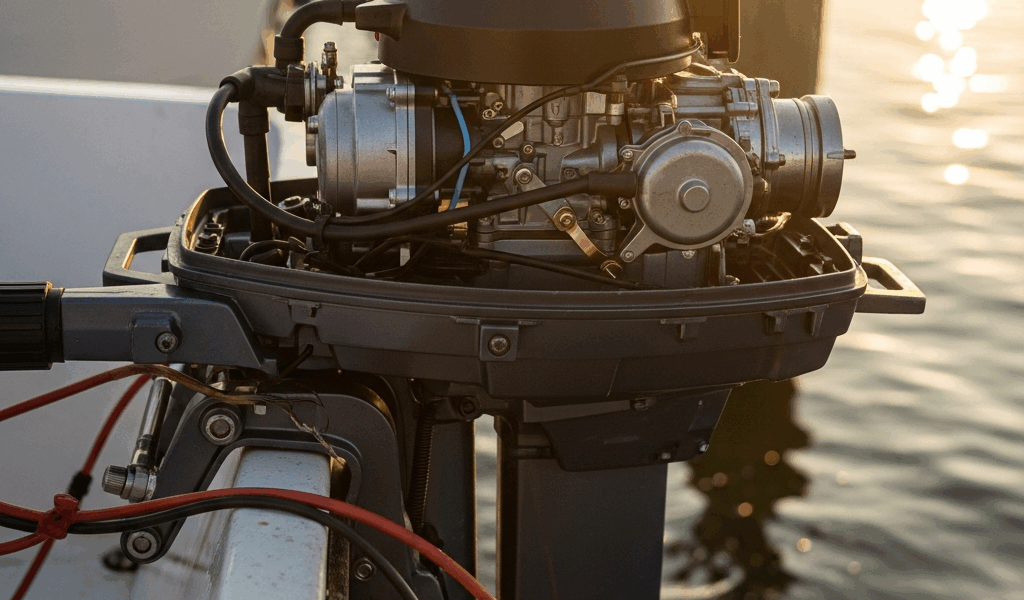
Why the Idle Circuit Is a Separate Beast
Outboard motor troubleshooting has gotten complicated with all the conflicting advice flying around. As someone who spent an entire weekend swapping spark plugs before realizing I was chasing the wrong system entirely, I learned everything there is to know about rough idle diagnosis the hard way. Today, I will share it all with you.
But what is the idle circuit, exactly? In essence, it’s a completely separate fuel delivery system running parallel to your main jet. But it’s much more than that — it’s the reason your engine can run butter-smooth at full throttle while sputtering like a dying lawnmower at 700 RPM.
At wide-open throttle, the main jet takes over. It’s fat, it moves serious fuel volume, and it masks almost every carburetor problem imaginable. At idle, though? Your engine is living off a tiny, precision-bored low-speed jet engineered to run on fumes. Different circuit. Different problems. Different fixes.
This is what most boat owners miss — cleaning the fuel injectors or swapping the fuel pump because the engine ran smooth at WOT doesn’t touch the idle problem. Not even close. The symptoms won’t budge. You’re chasing the wrong system. Probably should have opened with this section, honestly. Don’t make my mistake.
Start Here — Dirty or Clogged Carburetor Jets
The low-speed jet is the number-one culprit. Tackle it first because the fix is either free or costs under $15. Ethanol is the villain here — since 2007, pump gasoline in most US markets contains 10% ethanol, and ethanol absorbs water over time. Let a boat sit through one winter and that water-ethanol mix varnishes inside the carburetor. The idle jet — usually between 0.60 and 0.85 millimeters in diameter — gets packed with gunk.
The pattern is recognizable once you know it. Rough, stumbling idle at 600–800 RPM. Push the throttle past 2000 RPM and the engine smooths out completely. That transition point tells you everything. Main jet is fine. Low-speed circuit is starved.
Pull the carburetor bowl — usually four bolts, 10-minute job on most Yamaha, Mercury, or Suzuki models. The jet itself is a brass fitting roughly the size of a pencil eraser. Varnish buildup? Soak the bowl and jet assembly in carburetor cleaner for 30 minutes, then blow compressed air backward through the jet opening. A brass wire the diameter of a sewing needle can clear stubborn blockage — just don’t force it. That orifice is softer than you think.
Thick or black varnish means the fuel system sat too long or ran on old fuel. Pull the entire carburetor and soak it in a bucket of Marine Carburetor Cleaner — I use Yamaha part number 63D-W0093-00-00 or equivalent — for two full hours. Under $20 a bottle. Sometimes you’ll find a white powdery residue inside the float bowl. That’s corrosion from ethanol damage, and it means the idle circuit needs full attention, not just a quick rinse.
Fuel Delivery Problems That Only Show at Low RPM
So the jets are clean. Good. Now check whether fuel is actually reaching them at idle — because a clean jet starved of fuel still won’t fire.
Here’s the thing about idle: fuel demand drops to almost nothing. A weak fuel pump diaphragm or a cracked line will supply enough volume to keep the engine running at throttle, where demand spikes, but will starve the idle circuit entirely. The engine stumbles at rest while running fine at speed. Different symptom, same root cause.
Field test: squeeze the primer bulb. It should stay firm for at least 30 seconds. Goes soft within 10? The diaphragm is leaking. A replacement diaphragm kit runs $8–15 and takes about 20 minutes to install. While you’re there, check the fuel line — specifically where it connects to the carburetor, which is where cracks like to hide. Ethanol eats rubber fuel lines from the inside out. Soft or sticky line means replacement. Yamaha, Mercury, and Tohatsu all sell ethanol-rated fuel line — a 10-foot section costs $12–20.
Also pull the fuel filter bowl. Debris trapped there restricts flow at idle without choking the engine at full throttle, because high-speed demand simply overwhelms any restriction the filter creates. Dark or cloudy bowl means flush it and drop in a new filter element.
Spark and Ignition Issues Worth Ruling Out
A fouled spark plug won’t necessarily kill your engine at speed. The ignition fires anyway — just inconsistently. At idle, combustion chamber temps are lower and demand is light, so inconsistent firing becomes a rough, stumbling idle you can’t shake.
Pull the plugs and read them. Black and sooty means rich — too much fuel relative to air. White or tan is normal. One black plug and one clean plug? That cylinder has a local richness problem. Usually a stuck idle jet or a float set too high in that bowl specifically.
Gap new plugs to spec — usually 0.028–0.032 inches on outboards, though check your manual. Install them and run the engine. I’m apparently sensitive to plug condition and NGK BR8ES plugs work for me while cheap house-brand plugs never seem to gap consistently. If the idle clears up, you just saved $150 in diagnostic fees. That’s a win.
Idle still rough? Check the ignition coil resistance with a multimeter — inexpensive models start around $15. Compare readings against the service manual spec. A weak coil fires reliably at full throttle but struggles to ignite fuel cleanly under low load. Coil replacement runs $40–80 depending on the engine.
When to Adjust the Idle Mixture Screw
The idle mixture screw controls how much fuel enters the low-speed circuit. After cleaning the carburetor or replacing fuel system components, this is the final tuning step — not the first one.
Locate the screw on the carburetor body — your manual will show the exact spot, though it’s usually plainly visible. Start the engine and let it warm to operating temperature for five full minutes. Then turn the screw clockwise in quarter-turn increments, leaning the mixture. Listen for RPM to rise, then fall. When it falls, you’ve gone too lean. Back it out counterclockwise a half-turn and listen for the smoothest, steadiest idle. Most engines land somewhere between one and two turns out from full-in.
Still stumbling? Turn the screw out another full turn and repeat. You’re hunting for the sweet spot where idle is steady and throttle response has no hesitation.
One caution worth taking seriously — many EPA-regulated outboards from 2008 onward have sealed or fixed mixture screws. If yours won’t turn or is plugged with a tamper cap, don’t force it. A dealer or mobile marine mechanic with a fuel-air meter handles that adjustment. Voiding the warranty is expensive.
Cleaned the carburetor. Checked fuel delivery. Swapped plugs. Adjusted the mixture screw. Still rough? The problem has gone internal — weak compression in one cylinder, a stuck poppet valve, or a failing reed valve. Those require a compression test and professional diagnosis. Schedule the dealer visit. You’ve eliminated every easy fix, and that information alone saves the mechanic three hours of billable troubleshooting. That’s what makes methodical diagnosis endearing to us do-it-yourself boat owners — every step you complete is a step they don’t have to charge you for.




Stay in the loop
Get the latest maritimematterstoday updates delivered to your inbox.