Your marine battery died mid-season and you are standing in the marine supply aisle wondering whether you just got unlucky or whether you killed it yourself. Probably the second one. Most marine batteries die years before they should because of three mistakes that are easy to avoid once you know what they are.
But first — how long should a marine battery actually last? That depends entirely on the type you own, and a surprising number of boaters do not know which type is sitting in their battery compartment right now.
Marine Battery Lifespan by Type
Flooded lead-acid (FLA): 2–4 years with proper maintenance, 1–2 years with the mistakes covered below. Still common as starting batteries and in older trolling motor setups. They are the cheapest option upfront but require the most attention — checking water levels, cleaning terminals, avoiding deep discharge. Skip the maintenance and they sulfate internally within a season or two.
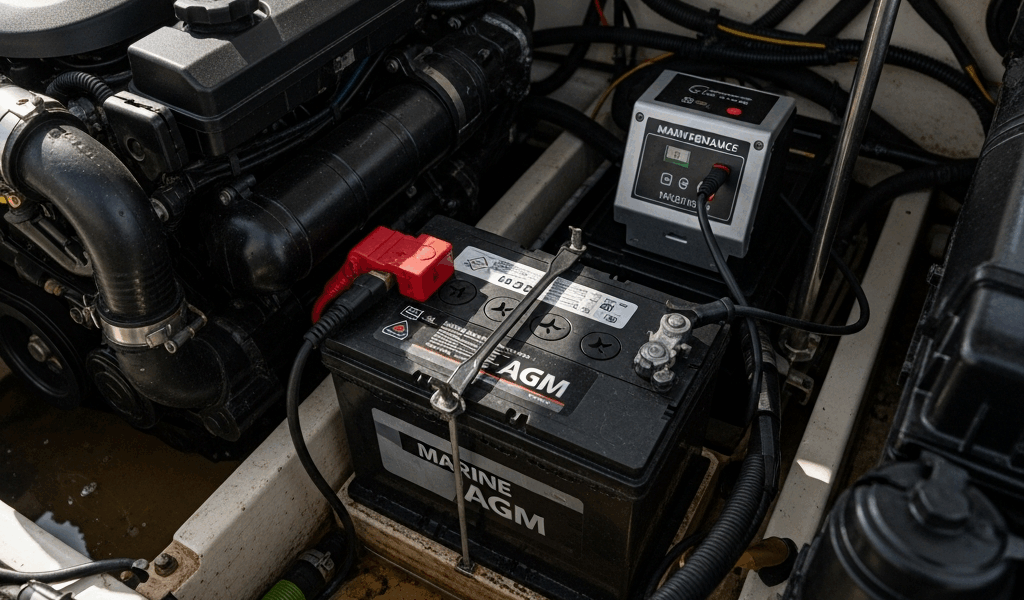
AGM (Absorbent Glass Mat): 4–8 years. More expensive than flooded, but sealed, maintenance-free, and significantly more tolerant of deep discharge cycles. AGM handles vibration better, performs better in cold weather, and does not leak acid if the battery case cracks. This is the current standard choice for most marine applications — starting, trolling, and house batteries.
Lithium (LiFePO4): 10–15 years or 2,000–5,000 charge cycles. The upfront cost is steep — $500–1,500 for a quality 100Ah battery — but the per-cycle cost is the lowest of any chemistry. You can discharge a lithium battery to 80% of its capacity without damage, versus 50% for AGM. The catch: you need a lithium-compatible charger. A standard marine charger can damage a lithium battery, and the other way around.
The Three Mistakes That Kill Marine Batteries Early
Deep discharging below the safe threshold. Lead-acid batteries — both flooded and AGM — sulfate internally when discharged too deeply. For AGM, the safe floor is 50% state of charge. A 100Ah AGM battery should be recharged when it drops to 50Ah remaining. For flooded batteries, the floor is even higher at about 50–60%. Guessing your state of charge is not reliable. Install a battery monitor — a Victron BMV or similar — and know your actual number. Every cycle below 50% costs you months of battery life.
Sitting discharged over winter. This one kills more marine batteries than anything on the water ever does. A fully discharged lead-acid battery stored through winter sulfates irreversibly within weeks. The sulfation crystals harden on the plates and permanently reduce capacity. The fix is simple: charge to 100% before winter storage, then either disconnect the battery and check it every 30–60 days, or connect a maintenance charger (Battery Tender, NOCO Genius) that holds the charge without overcharging. A $30 maintenance charger can add 2–3 years to battery life.
Using the wrong charger. A standard automotive charger on a marine AGM battery can overcharge and gas the cells, permanently damaging the sealed design. AGM batteries require an AGM-mode charger that limits voltage to 14.4–14.7V during bulk charge. Lithium batteries require a lithium-specific charger with a different voltage profile. Charging a lithium battery with a lead-acid charger risks thermal damage. Check your charger’s settings before you plug in — the wrong mode is worse than not charging at all.
Signs Your Marine Battery Needs Replacement
Starting battery: slow cranking on a warm morning is the clearest sign. Cold-weather sluggishness is normal — batteries produce less power in cold temperatures. But if your engine cranks slowly at 75 degrees, the battery has lost significant cranking capacity. Do not wait for it to fail on the water.
Trolling motor battery: if your motor runtime has noticeably shortened compared to when the battery was new, or voltage drops below 10.5V under load before you expect it to, the battery has lost cycling capacity. A voltmeter under load tells you more than a resting voltage reading.
Load test: the definitive answer. Apply 50% of the battery’s CCA rating for 15 seconds and measure the voltage. If it drops below 9.6V during the test, the battery is failing. Most marine shops and auto parts stores will load-test for free or $10. If a 3-year-old AGM tests below 80% of rated capacity, plan to replace it before next season.
Storage Protocols That Add Years to Marine Battery Life
Charge to 100% before storage — not partial charge, not “close enough.” A fully charged lead-acid battery freezes at a much lower temperature than a discharged one. A discharged battery can freeze and crack at temperatures a charged battery handles without issue.
Disconnect the battery from all loads. Even small parasitic draws — a bilge pump float switch, a fish finder with a clock, a stereo memory circuit — can drain a battery over three months of storage. Disconnect the terminals or install a battery disconnect switch.
Clean terminals with a baking soda and water solution. Coat with dielectric grease to prevent corrosion during storage. Store in a cool, dry location — heat accelerates self-discharge and internal degradation.
Use a maintenance charger. A NOCO Genius 2 ($30) or Battery Tender Plus ($45) holds the battery at full charge through the entire off-season without overcharging. This single investment is the highest-return money you can spend on marine battery longevity. A properly maintained AGM battery with winter float charging will comfortably hit 6–8 years of service. The same battery stored discharged and forgotten will be dead in two seasons.

Stay in the loop
Get the latest maritimematterstoday updates delivered to your inbox.