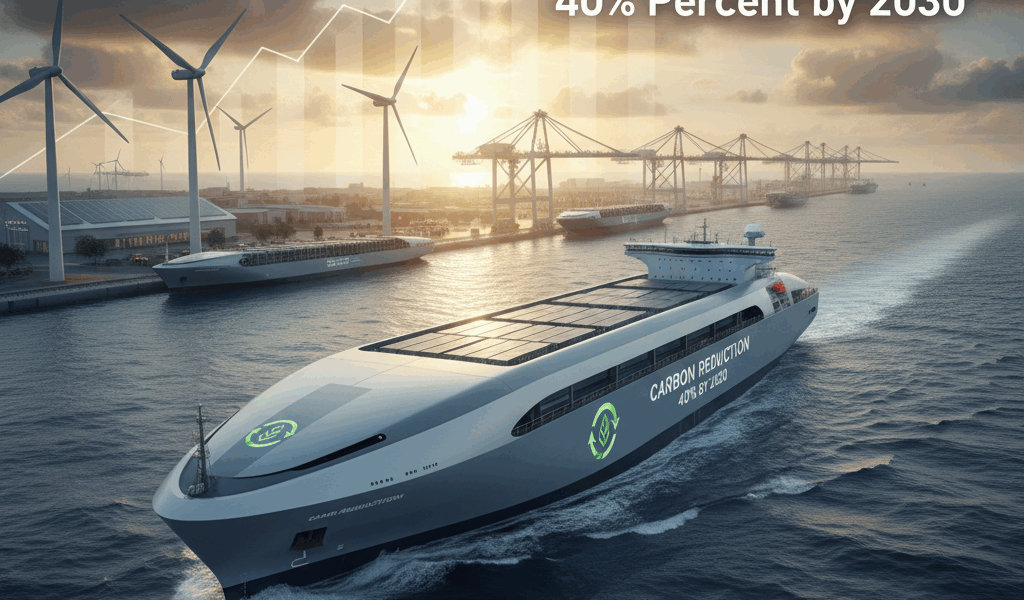
Maritime decarbonization has gotten complicated with all the emission targets and fuel alternatives flying around. As someone who’s tracked shipping’s environmental evolution closely, I learned everything there is to know about where we’re actually headed by 2030. Today, I will share it all with you.
The Scale of Maritime Emissions

International shipping moves approximately 90 percent of global trade, powering the world economy with a fleet of more than 50,000 cargo vessels. This massive industry also produces significant greenhouse gas emissions—roughly 3 percent of global CO2, comparable to major industrial nations.
The International Maritime Organization (IMO), the United Nations agency responsible for shipping regulation, has set ambitious targets to address this environmental impact. By 2030, the organization aims to reduce shipping’s carbon intensity by at least 40 percent compared to 2008 levels. Achieving this goal requires fundamental changes to how ships are powered, operated, and regulated.
Understanding the 2030 Target
Probably should have led with this section, honestly. The IMO’s 2030 target focuses on carbon intensity rather than absolute emissions. Carbon intensity measures emissions relative to the transport work performed—essentially, how much CO2 is produced to move a given amount of cargo a given distance.
This approach recognizes that global trade continues to grow, making absolute emission reductions difficult without constraining economic activity. By improving efficiency, ships can carry more cargo while producing less pollution per ton-mile.
The 40 percent target represents a minimum goal. The IMO’s broader strategy aims for net-zero greenhouse gas emissions by approximately 2050, with interim targets in 2040. Meeting these goals requires a combination of operational improvements, new technologies, and alternative fuels.
Current Regulatory Framework

The IMO has implemented several mandatory measures to drive emission reductions:
Energy Efficiency Design Index (EEDI)
Since 2013, all new ships must meet minimum efficiency standards that become progressively stricter over time. The EEDI requires naval architects to design vessels that produce fewer emissions per unit of transport capacity. This has driven innovations in hull design, propeller efficiency, and engine technology.
Energy Efficiency Existing Ship Index (EEXI)
Recognizing that the existing fleet will continue operating for decades, the IMO introduced EEXI requirements that apply to ships already in service. Vessels that don’t meet efficiency thresholds must implement modifications—often including engine power limitations—to reduce their emissions.
Carbon Intensity Indicator (CII)
That’s what makes CII so important to understand. It rates ships on an A-to-E scale based on their operational carbon intensity. Ships rated D for three consecutive years or E for one year must submit corrective action plans. This creates ongoing pressure to improve performance, even for vessels that meet initial efficiency requirements.
Operational Measures That Work Now
While alternative fuels remain under development, ship operators are implementing operational changes that reduce emissions immediately:
Slow steaming has become widespread since fuel costs spiked in the 2000s. Reducing speed by even a few knots dramatically cuts fuel consumption—and emissions—since fuel use increases exponentially with speed. Many vessels now operate well below their design speeds.
Weather routing uses forecasting data to optimize voyage planning, avoiding headwinds and adverse currents that increase fuel consumption. Modern routing systems can suggest speed profiles that minimize fuel use while meeting schedule requirements.
Hull and propeller maintenance prevents the efficiency losses that accumulate as marine growth and corrosion degrade hydrodynamic performance. Regular cleaning and coating application can improve efficiency by several percentage points.
Just-in-time arrival coordinates vessel speed with port readiness, eliminating the practice of racing to port only to wait at anchor. This approach reduces fuel consumption while also decreasing congestion at major ports.
The Fuel Transition Challenge
Operational improvements alone cannot achieve the 2030 target. The shipping industry must transition to alternative fuels that produce fewer—or zero—emissions. Several options are under development:
LNG (Liquefied Natural Gas)
LNG produces approximately 25 percent fewer CO2 emissions than traditional marine fuel oil, along with dramatic reductions in sulfur and particulate emissions. However, methane slip—unburned fuel escaping through engines—can offset climate benefits. LNG is best understood as a transitional fuel rather than a long-term solution.
Methanol
Methanol can be produced from renewable sources, potentially offering near-zero lifecycle emissions. Several major shipping companies have ordered methanol-fueled vessels, and infrastructure is developing at key ports. The fuel handles more easily than LNG, simplifying bunkering operations.
Ammonia
Ammonia produces no direct CO2 emissions when burned and can be produced using renewable electricity. However, safety concerns around its toxicity require specialized handling equipment, and engine technology is still maturing. Many analysts see ammonia as a leading candidate for zero-carbon shipping after 2030.
Hydrogen
Hydrogen offers the cleanest combustion profile but presents significant storage challenges. Its low energy density requires much larger fuel tanks than conventional fuels, reducing cargo capacity. Hydrogen may prove more practical for short-sea shipping where range requirements are limited.
Wind-Assisted Propulsion
Interest in wind power has revived as shipping seeks emission reductions. Modern wind-assisted propulsion systems don’t replace engines but supplement them, reducing fuel consumption by 5 to 30 percent depending on trade route and technology.
Options include rigid wing sails, Flettner rotors (spinning cylinders that generate thrust), and kite systems that capture high-altitude winds. Several commercial vessels now operate with these systems, demonstrating their viability for certain applications.
What 2030 Compliance Looks Like
Meeting the 2030 target will require most shipowners to take action beyond current operations. The likely combination includes:
- Continued slow steaming on routes where schedule permits
- Energy-saving devices installed on existing vessels
- Newbuilds designed for alternative fuels or dual-fuel capability
- Shore power connections at ports to eliminate emissions at berth
- Biofuels blended with conventional fuel as drop-in replacements
The specific mix will vary by ship type, trading pattern, and owner strategy. Containerships on fixed schedules face different constraints than bulk carriers on spot charter.
Enforcement and Compliance
The IMO relies on flag states—the countries where ships are registered—to enforce its regulations. Port state control provides additional oversight, with inspectors verifying that vessels calling at their ports meet international requirements.
Critics note that enforcement varies significantly between flag states, and some ship operators may seek registries with lighter oversight. The IMO has proposed strengthened mechanisms, including carbon pricing that would create economic incentives for compliance regardless of flag.
Investment Decisions Now Shape 2030 Outcomes
Ships ordered today will still be operating in 2030 and beyond. Owners and operators face difficult decisions about which fuel pathways to pursue, with significant capital at stake. The choices made in the next few years will determine whether the industry meets its targets—and which companies lead the zero-carbon transition.
For the broader maritime industry, the 2030 target represents both challenge and opportunity. Companies that develop efficient vessels, alternative fuel infrastructure, and green shipping services will capture growing market share as customers and regulators demand lower emissions. Those that delay may find themselves operating obsolete assets in an industry transformed by the decarbonization imperative.