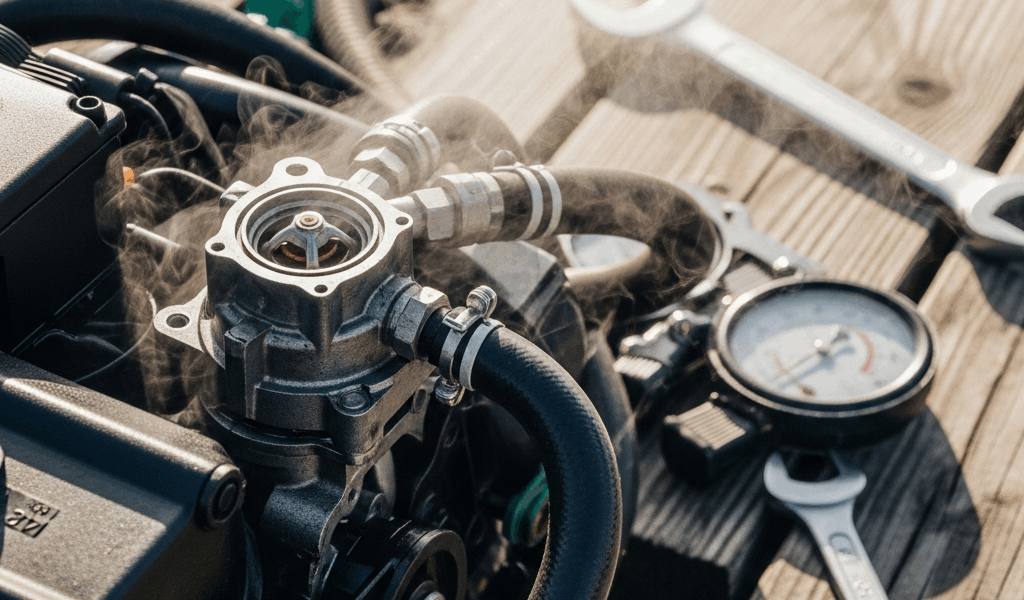
Why Your Boat Engine Is Overheating
Boat engine overheating has gotten complicated with all the forum noise and conflicting advice flying around. As someone who has cooked an engine on a Tuesday afternoon in August — watching the temp gauge crawl into the red while tied to my own dock — I learned everything there is to know about marine cooling systems the expensive way. Today, I will share it all with you.
Here’s the thing almost nobody tells you upfront: every cooling system fails in exactly one of two places. Either water stops coming in, or heat stops getting out. That’s it. Two buckets. Once you understand that, the whole diagnostic process shrinks down to something manageable — at least if you approach it in the right order. Easiest first. Cheapest first. Least destructive first.
What follows is the same mental flow a marine tech runs through on the water. Check one thing, get an answer, move on. No parts cannon. No expensive guessing.
Check the Tell-Tale Stream First
But what is the tell-tale? In essence, it’s a small white plastic tube — sometimes 3/8 inch diameter, sticking out of the engine block or transom arm — that lets raw cooling water escape so you can actually see it moving. But it’s much more than that. It’s your fastest free diagnostic tool. Some people call it the “pee hole.” That name is accurate.
Engine running? Look at the tell-tale. Right now.
Strong, steady stream? Good. Raw water is moving through the system. You can cross off blocked intake and dead impeller and move down the list. That’s what makes the tell-tale endearing to us boaters — one glance and you’ve already eliminated the most common failures.
Weak stream, or occasional spurts? Something is restricting flow without blocking it entirely. Partially clogged intake screen, maybe. Early barnacle buildup on the lower unit. An impeller starting to shed its blades. Worth noting before you move on.
No stream at all? Stop the engine. Don’t idle it down gently. Don’t finish the sentence you were saying to your passenger. Stop it. Running without cooling water for even three or four minutes can warp a cylinder head — or destroy a brand-new impeller before you’ve reversed out of the slip.
Inboard owners: your setup looks different. You’re checking a through-hull fitting with a clear hose running to a visible outlet, or monitoring coolant level and color in a closed-loop system. Same principle applies, though. Visual confirmation that water is actually moving.
Impeller Failure — the Most Common Culprit
Probably should have opened with this section, honestly.
Frustrated by a mystery tell-tale that showed nothing on a Saturday at 2 p.m. with a full cooler onboard, I learned about impellers the way most boaters do — by needing a new one immediately, with no marine store open nearby. My nearest West Marine was 40 minutes away. I’m apparently the type who never carried a spare, and that $35 part cost me an entire afternoon. Don’t make my mistake.
The impeller is a rubber-bladed wheel — looks like a small rubber daisy — sitting inside your water pump housing. It spins, pulls seawater in, pushes it through the engine. Simple job. When it fails, water stops moving and the engine overheats fast.
Three ways it dies. Age — rubber gets brittle, usually around the two-year mark. Running dry — you fired up without the flushing muffs seated properly, or the intake clogged mid-run, and the impeller spun against nothing and shredded itself in seconds. Debris — a shell fragment or small pebble gets sucked in and tears the blades clean off.
Here’s how to confirm it: shut the engine down. Check the tell-tale again. Still dry? Remove the tell-tale fitting if you can reach it safely, or inspect the intake area. A dying impeller sheds rubber chunks — you might actually see dark fragments inside the housing. That’s your confirmation.
Replacement impellers run $25 to $80 depending on your engine. A Mercury 90 four-stroke takes a Jabsco 18673-0001 — about $42 at most retailers. The swap takes 20 minutes if you’ve done it before, 45 minutes if you’re watching a YouTube video on your phone with greasy thumbs. Skill level is basic mechanical confidence. Nothing more.
What you absolutely don’t do: don’t restart the engine to “test” the fix if the tell-tale was dry and you suspect impeller failure. A fresh impeller spinning without water self-destructs in under ten seconds. I have watched this happen. It’s demoralizing and expensive.
Swap your impeller every two seasons regardless of how it looks. The rubber degrades whether you run the boat hard or not. A $40 part on a Tuesday beats a blown engine on a holiday weekend.
Thermostat, Blockage, and Exhaust Issues
You have a tell-tale stream. Good. Your impeller is probably fine. Now the list gets slightly more involved.
A stuck thermostat won’t let coolant circulate the way it should — the engine climbs and stays hotter than normal even with water flowing. Quick field test: with the engine warm, carefully touch the hoses running to and from the thermostat housing. One should be noticeably hotter than the other. If both feel equally hot almost immediately, the thermostat is stuck closed. It’s not regulating anything. Replacement runs $150 to $400 depending on engine type and who does the work. Moderate skill level — you’re draining coolant, unbolting a housing, swapping a cartridge, and refilling. Doable on a Saturday morning if you’ve got a Haynes manual or a good YouTube channel open.
The intake screen — that strainer bowl where raw water enters the engine — clogs with weeds, debris, and the general chaos of wherever you boat. Close the through-hull valve, unscrew the bowl, rinse it under a hose, reinstall. Five minutes. Free, unless the gasket crumbles when you pull it, in which case you’re looking at maybe $3 for a replacement. Check this one monthly during the season. It takes less time than checking the oil.
Barnacle and shell buildup on the lower unit of outboards — or on the intake fitting of inboards — restricts flow gradually enough that you might not notice until the engine is already running hot. You’ll see a white or grey crusty layer around the intake opening. Wire brush it off. White vinegar applied with a rag loosens heavy calcium buildup. This is a 15-minute job at the end of a haul-out and it matters more than most people realize.
Exhaust restrictions — kinked hose, collapsed muffler, water backing up through the exhaust — can trap heat in the block. Less common than the others, but worth mentioning. You’ll usually see symptoms beyond simple overheating: white smoke from the exhaust, or milky tan-colored oil on the dipstick where water has mixed in. That combination warrants a marina call unless you already know exhaust systems well.
When to Stop and Call for Help
If the engine ran hot for more than a few minutes before you caught it, there’s a real possibility of damage already done — warped head gasket, scored cylinder walls, coolant mixed into the oil. Don’t run it again to “test the fix.” That’s how a $200 repair becomes a $3,000 engine rebuild.
Signs the engine is seriously hurt: white smoke coming from the exhaust or under the cowling, milky or tan oil on the dipstick, rough idle after it cools back down, or steam from the engine compartment even after shutdown. Any one of those means stop immediately and call the marina.
The rule I follow now — and I learned it the hard way after a very bad July afternoon — is simple. If I can’t identify the cause within five minutes of safe inspection, the engine doesn’t run again until a mechanic has looked at it. Frustrating? Yes. Cheaper than guessing? Every single time.
Prevention is where you actually win. Swap the impeller every two seasons. Rinse the intake screen once a month during boating season. Watch the temperature gauge every time you’re underway and listen for that tell-tale stream. Keep the engine cool and it’ll run for decades without drama. Let it overheat repeatedly while you’re troubleshooting and you’ll be shopping for a rebuild — or a different boat entirely.




Stay in the loop
Get the latest maritimematterstoday updates delivered to your inbox.