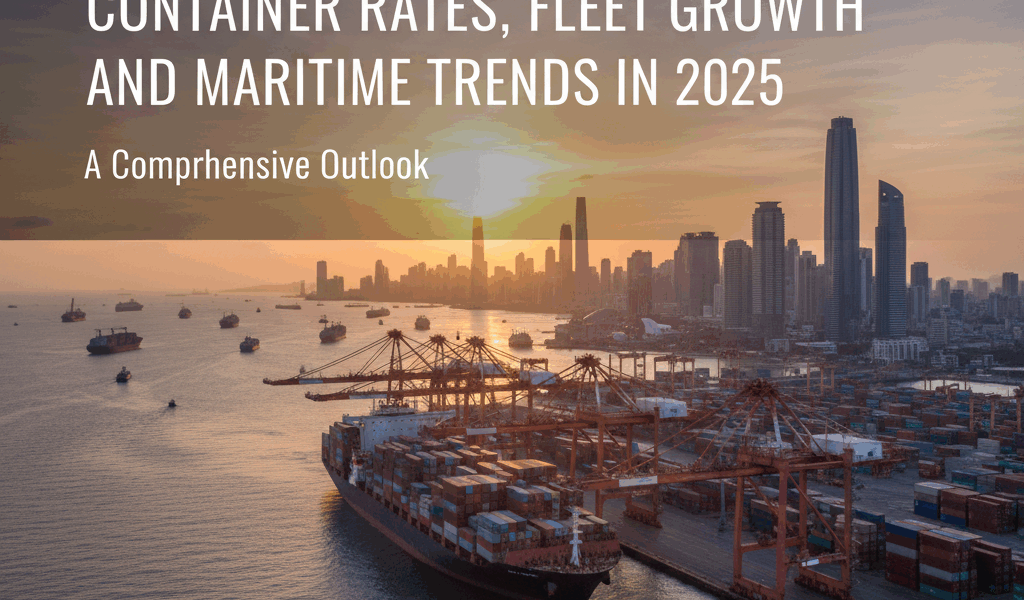
Global shipping markets have gotten complicated with all the capacity dynamics and trade pattern shifts flying around. As someone who’s tracked the industry through multiple cycles, I learned everything there is to know about where we stand entering 2025. Today, I will share it all with you.
A Market Finding Its Balance
The maritime industry enters 2025 navigating between the extremes that characterized recent years. The pandemic-era chaos—when container rates briefly touched $20,000 per twenty-foot equivalent and ships queued for weeks outside major ports—has given way to a more normalized market. Yet the adjustments aren’t complete, and significant changes continue reshaping how goods move by sea.
Understanding where the industry stands requires examining the major market segments, the capacity decisions being made, and the structural changes that will influence maritime trade for years to come.
Container Shipping: Normalization With Caveats
Container freight rates have returned to historical norms after years of extraordinary volatility. The Shanghai Containerized Freight Index, which tracks rates from China to major destinations, shows values roughly consistent with pre-pandemic levels—a dramatic correction from peaks that saw some routes command ten times normal prices.
This normalization reflects several factors:
- Reduced congestion – Port bottlenecks have largely cleared as pandemic disruptions faded
- Demand moderation – Consumer spending has shifted from goods back toward services
- Capacity additions – New ships ordered during the boom are entering service
- Improved productivity – Ports and logistics chains have recovered operational efficiency
Probably should have led with this section, honestly. The caveat is that capacity growth now exceeds demand growth. Carriers ordered aggressively during the profitable pandemic period, and those ships are arriving just as markets soften. Managing this overcapacity will challenge the industry through at least 2026.
Carriers have responded by slow-steaming, blanking sailings, and scrapping older vessels earlier than planned. The alliances that dominate liner shipping provide mechanisms for coordinating capacity, though antitrust scrutiny limits how explicitly carriers can manage supply.
Fleet Growth Trajectories

The global fleet continues to expand across all major segments, though growth rates vary significantly by vessel type.
Container ship capacity is growing fastest, with the orderbook representing roughly 25 percent of the existing fleet. Many of these new vessels are significantly larger than ships they replace, concentrating capacity on major trade lanes while cascading older tonnage to secondary routes.
That’s what makes fleet renewal so critical right now. Tanker markets face tighter supply. Years of limited ordering have left the crude carrier fleet aging, with the orderbook at historically low levels. This supply constraint has supported rates even as demand growth moderates.
Bulk carrier ordering has picked up after a subdued period, with owners responding to improved earnings and anticipating eventual fleet renewal needs. The segment remains less volatile than containers or tankers, tracking broader economic activity.
The Dual-Fuel Transition
New ship orders increasingly specify dual-fuel capability, reflecting the industry’s hedging strategy for decarbonization uncertainty. Approximately 40 percent of container ship capacity on order can burn alternative fuels—primarily LNG but increasingly methanol.
This represents a dramatic shift from just five years ago when nearly all newbuilds burned conventional fuel. The transition imposes costs—dual-fuel vessels cost 10-15 percent more than conventional ships—but provides optionality as regulations tighten and fuel availability evolves.
The implication for existing vessels is significant. Ships built without alternative fuel capability may face competitive disadvantage as charterers increasingly specify environmental performance. Retrofit options exist but are expensive and not always practical.
Red Sea Disruptions
Security concerns in the Red Sea have forced many carriers to divert around the Cape of Good Hope, adding roughly 3,500 nautical miles and two weeks to Asia-Europe voyages. This disruption effectively removes capacity from the market, as ships spend more time in transit.
The impact has varied by segment. Container carriers, with their fixed schedules and hub-and-spoke networks, absorbed significant disruption. Tanker and bulk carrier operators, with more flexible routing, adapted more easily.
As of early 2025, most major container lines continue avoiding Red Sea transits, with no clear timeline for resumption. The extended Cape routing has become the new normal for Asia-Europe services, with rates and transit times adjusted accordingly.
Regional Trade Patterns
Global trade flows continue to evolve, with several trends shaping demand for maritime transport.
Asia intra-regional trade has grown faster than intercontinental movements, reflecting manufacturing shifts within the region and rising consumer demand in Southeast Asia and India. Carriers have added capacity on intra-Asian routes to serve this growth.
US imports from China have declined as a share of total imports, though absolute volumes remain substantial. Diversification toward Vietnam, India, and other manufacturing centers is gradual but persistent.
European energy trade has restructured following changes in gas supply patterns. LNG import volumes have surged, with corresponding growth in LNG carrier demand and terminal utilization.
Port Investment Continues
Major ports worldwide continue investing in capacity and capability, responding to vessel size growth and efficiency demands.
Automation remains a key theme, though implementation experiences have varied. Fully automated terminals offer operational efficiency but require massive capital investment and can struggle with the variability inherent in container operations. Hybrid approaches combining automation with human oversight are increasingly common.
Shore power installations are expanding as ports address ship emissions at berth. California mandates have driven adoption on the US West Coast, with European ports implementing similar requirements. This infrastructure investment signals the importance ports place on environmental performance.
Regulatory Implementation
The regulatory environment continues to tighten. Key developments affecting 2025 operations include:
CII ratings are now affecting commercial decisions, with charterers increasingly specifying minimum performance levels. Ships with poor ratings face reduced commercial options.
EU ETS inclusion brought shipping into Europe’s emissions trading system, adding carbon costs to voyages touching European ports. The financial impact is material for vessels with poor efficiency.
Ballast water requirements are now universally enforced, with the extended implementation period having concluded. Vessels without compliant systems face port state control consequences.
Technology Integration
Digital technology continues permeating maritime operations, though adoption remains uneven.
Electronic Bills of Lading have achieved critical mass on some trade lanes, with the legal frameworks enabling paperless documentation now in place across major trading nations. The efficiency gains—faster document transfer, reduced fraud risk, lower costs—are compelling early adopters.
Predictive maintenance using sensor data and machine learning is reducing unplanned downtime for early adopters. The technology works best for critical systems where failure consequences are severe.
Port community systems increasingly integrate vessel operations, cargo handling, and logistics coordination, reducing waiting time and improving asset utilization.
The Year Ahead
Maritime shipping in 2025 faces a familiar challenge: matching supply and demand in a cyclical industry. The capacity additions flowing from pandemic-era orders will pressure rates, particularly in container shipping. How carriers manage this overcapacity—through slow-steaming, scrapping, layups, or alliance coordination—will determine profitability.
Longer term, the industry is positioning for structural changes that will unfold over the next decade. The fuel transition, environmental regulation, and evolving trade patterns will reshape competitive dynamics. Companies investing in efficiency, flexibility, and environmental performance are betting that these factors will increasingly differentiate winners from losers.
For maritime professionals, the message is clear: understand both the cyclical pressures affecting near-term operations and the structural changes shaping long-term strategy. The industry that emerges from this period will differ significantly from the one that entered it.



Stay in the loop
Get the latest maritimematterstoday updates delivered to your inbox.