What Outboard Surging Actually Means
Outboard motor surging has gotten complicated with all the misdiagnosis flying around online. People confuse it with stalling, hesitation, bog — you name it. So let me be clear about what surging actually is before we go any further.
Surging at full throttle feels like rhythmic punches of power. The engine climbs in RPM, drops back, climbs again. Every few seconds. Over and over. It’s not dying. It’s not hesitating on acceleration. It’s running hard and refusing to hold a steady number. At WOT — wide open throttle — you feel the boat lurch forward, ease back, lurch forward again. That’s surging. And it means something is starving the engine of fuel or signal at exactly the moment it demands the most.
Hesitation is different — a flat spot when you crack the throttle. Stalling is a full loss of ignition. Surging happens while you’re already running wide open. If your motor dies at full throttle instead of cycling like this, you’re chasing a different problem entirely. If it hesitates only during acceleration and then smooths out at speed, that’s also not what we’re fixing here. Know what you have before you start pulling things apart.
So, without further ado, let’s dive in.
Fuel Delivery Problems Cause Most Full-Throttle Surges
Nine times out of ten, this is where it lives. Fuel isn’t reaching the cylinders fast enough. The engine screams for gas, the carb or injectors call for it, and the supply line shows up late or weak. Full throttle is where this breaks down hardest — demand is absolute, and the system either keeps up or it doesn’t.
Clogged Fuel Filter — Start Here First
Probably should have opened with this section, honestly. A dirty fuel filter is the most common culprit and the cheapest fix. You’ll run fine at idle. Half throttle, no issue. But at WOT the engine gulps fuel faster than the clogged filter allows, pressure drops, and surging starts.
The fix is dead simple. Find the filter bowl — small clear cylinder, usually mounted on the engine block or on the fuel line somewhere between the tank and carb. Unscrew it, dump the old filter element, drop in a new one. OEM filters run eight to fifteen dollars. Off-brand, half that. Get a new gasket too — they’re a dollar, maybe two. I’m apparently the person who skipped gaskets for three seasons and then couldn’t figure out why my filter housing kept weeping fuel. Don’t make my mistake.
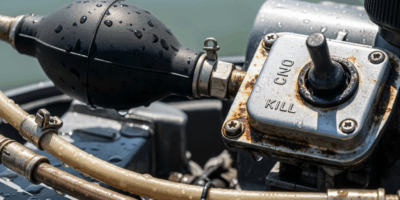
Quick field test: squeeze the primer bulb hard, ten times fast, while the engine idles. If the surging improves or stops right at that moment, fuel delivery was already borderline before you even throttled up. A fresh filter usually ends the whole conversation.
Fuel Pump Weakness
An outboard’s fuel pump builds pressure to force fuel toward the carbs or injectors. Mechanical pump on older carbureted engines. Electric pump on newer EFI models. When it weakens, it can’t keep pace at full throttle — and you feel it.
Surging only at WOT. Occasional stalling under hard load. A tendency to behave better after the engine sits and cools for an hour or two. That’s the pattern. Weak pumps also fail intermittently, which is maddening — one day everything runs perfectly, the next day you surge for ten minutes and then it clears up like nothing happened.
A fuel pressure gauge tells the story fast. Twenty-five to forty dollars, clamp it inline on the fuel line. On carbureted outboards you’re looking for 4 to 6 psi at WOT. EFI engines want 35 to 60 psi depending on the model. If pressure drops below those marks when you rev hard, the pump is losing strength. Replacement pumps cost forty to one hundred fifty dollars depending on the engine — this job usually calls for a mechanic unless you’re already comfortable working inside the powerhead.
High-Speed Jet Blockage (Carbureted Engines Only)
The high-speed jet is a tiny brass tube inside the carburetor. It delivers fuel during cruise and full throttle. When varnish from old fuel or ethanol blends clogs it even partially, the engine starves at high RPM and surges.
But what is varnish? In essence, it’s the sticky residue that old gasoline leaves behind as it degrades. But it’s much more than that — it acts like internal plaque, coating jets and passages until fuel barely trickles through.
You’ll notice this only at full throttle or right near it. Mid-range feels fine. Idle is perfect. Push to WOT and the engine spits and surges because the jet simply can’t flow enough fuel to keep up. This is a carburetor-off, internal-cleaning job. A professional cleaning runs seventy to one hundred fifty dollars per carb. On twin or triple carb setups the cost stacks, but usually only one carb is truly blocked — check the easy one first.
Carburetor Issues That Trigger Surging Under Load
Carbureted outboards have two enemies: ethanol fuel and time. Both create varnish that clogs jets and gums up internal passages. Surging is a textbook symptom of either one.
Float Level Out of Spec
The float inside the carb rises and falls with fuel level, controlling how much fuel enters the bowl. When the float is bent, stuck, or its lever is worn, the bowl doesn’t fill to the correct height. Low fuel in the bowl means low fuel pressure at the jet — especially obvious at full throttle when the engine is sucking hard.
The sign: surging at WOT, but the motor starts and idles like nothing is wrong. You might also catch a whiff of raw fuel leaking from the carb overflow tube — that small tube that hangs below the carb body.
A carburetor specialist inspects the float and lever visually, bends it back into spec or swaps it. Five-minute job once the carb is off the engine. Part cost is zero if it’s just a bent tab. Maybe thirty dollars if you need a new float assembly.
Carburetor Base Gasket Air Leak
The rubber gasket sealing the carb to the intake manifold hardens over years of heat cycling. Tiny cracks develop. Unmetered air sneaks past. That extra air leans out the fuel mixture, the engine stumbles under load, and surging follows — particularly at full throttle where the engine is most sensitive to mixture changes.
Frustrated by months of chasing electrical gremlins, many boaters eventually find the real culprit using a simple propane torch with the flame off. Spray a small amount of propane gas around the gasket edge while the motor runs — any RPM change or audible hiss pinpoints where the leak is entering.
New base gaskets cost three to eight dollars. Installation is about an hour if the carb needs to come fully off, or thirty minutes if you can reach the mounting bolts without complete removal.
EFI and Sensor Faults on Fuel-Injected Outboards
Modern fuel-injected outboards have different failure modes entirely. Surging usually points to a sensor feeding wrong signals to the ECU — not a mechanical clog you can clean with a spray can.
Throttle Position Sensor (TPS) Drift
The TPS tells the engine computer exactly how far open the throttle is. If it drifts out of calibration or fails outright, the ECU can’t meter fuel correctly at full throttle. The engine overshoots on fuel delivery, backs off, overshoots again. Classic surge pattern.
A bad TPS usually throws a check engine light. An OBD-II scanner — seventy-five to one hundred fifty dollars, or free at most auto parts chains — will pull codes P0120 or P0122 to confirm it. Without a scanner you’re essentially guessing in the dark.
Replacement TPS runs forty to eighty dollars for the part itself. Installation is thirty minutes if you’re comfortable with electrical connectors. A mechanic will charge around two hundred dollars in labor — at least if they’re billing at standard marine shop rates.
MAP Sensor (Manifold Absolute Pressure)
The MAP sensor reads engine load and signals the ECU when to enrich or lean the mixture. A failing MAP sensor sends garbage data, the ECU makes bad trim decisions, and surging at WOT is one consequence. Check engine codes P0106 or P0108 point directly to MAP trouble.
These sensors cost thirty to one hundred dollars depending on the engine and take about ten minutes to swap once you locate them — usually mounted on the intake manifold or engine block, sometimes buried under a bracket. That is because the MAP sensor location was apparently not a priority for accessibility in most engine designs.
Idle Air Control (IAC) Valve Issues
The IAC valve regulates bypass air when the throttle is near-closed. On some EFI outboards, a stuck or carbon-fouled IAC causes surging across the RPM range — including at full throttle. Less common than TPS faults, but worth investigating if the TPS tests clean.
Carbon from old fuel or engine blow-by can freeze the IAC partially open. Cleaning means removing the valve and soaking it in carburetor cleaner or hitting it with dedicated IAC cleaner spray. Fifteen to forty dollars for a replacement if cleaning doesn’t bring it back.
When to Stop Diagnosing and See a Mechanic
While you won’t need a fully equipped marine shop to change a fuel filter, you will need a handful of specialized tools and real experience once things move past basic maintenance. Internal fuel pump failure requires engine disassembly. Fuel injector replacement on EFI engines involves depressurizing the fuel system. ECU reprogramming or replacement needs dealer-level diagnostics. These jobs sit firmly outside home-mechanic territory for most people.
A cracked fuel line or a misaligned filter bowl housing is not worth saving ten dollars over. The fire risk alone makes professional help the smarter call. Stop before you break something expensive — or dangerous.
That’s what makes catching surging early endearing to us boaters who actually want to keep our engines alive. Fix it at the fuel filter stage and you’re out fifteen dollars and twenty minutes. Ignore it until the engine is heat-cycling under constant load and you’re looking at internal damage that costs thousands. Catch it now and keep running another ten seasons.



Stay in the loop
Get the latest maritimematterstoday updates delivered to your inbox.