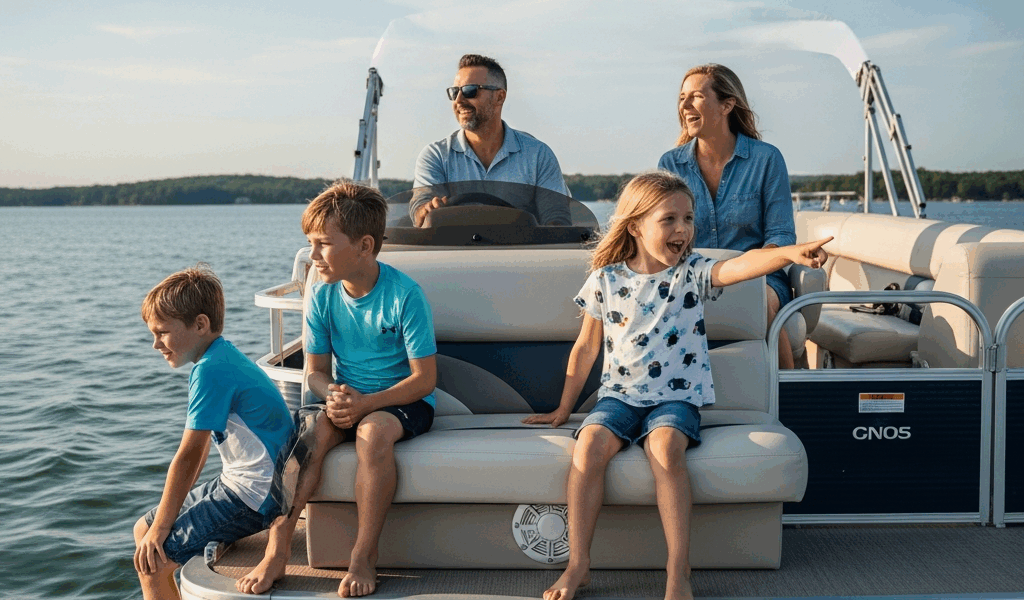
You are spec’ing out a new pontoon boat and the dealer just told you adding a second engine will cost $15,000–30,000 more depending on the horsepower. You are sitting there thinking — is that actually worth it, or is this the marine equivalent of the extended warranty upsell?
It depends on exactly three things: how many people you regularly carry, whether you do water sports, and how much you value redundancy when you are miles from the dock. For most recreational lake users, a single engine is the right call. But there is a specific buyer profile where twin engines genuinely earn their premium.
What a Second Engine Actually Adds
Speed under load. This is where twins shine. A single 200hp on a 26-foot pontoon with twelve people aboard struggles to plane and tops out around 20–22 mph. Twin 115s on the same boat produce more low-end torque and push through the plane-off transition faster, reaching 28–32 mph with the same passenger load. For pulling a tube or wakeboarder with a full boat, twins make a measurable difference.
Redundancy. If one engine develops a problem on the water — overheating, fuel issue, prop strike — you idle home on the other. On a single-engine boat, a dead motor means calling for a tow. The peace-of-mind value depends on where you boat. Small inland lake with cell coverage and a marina two miles away? Tow is an inconvenience. Open bay with a six-mile run to the ramp? Redundancy has real safety value.
Load capacity compliance. Pontoon manufacturers rate boats for maximum horsepower. Twin engines let you reach higher total horsepower within the boat’s transom rating and weight specifications, which matters for heavier boats in the 24–28 foot range designed for large groups.
Fuel consumption. Roughly doubles at cruise speed compared to a single engine of equivalent total horsepower. This is the tradeoff nobody at the boat show mentions first.
Barletta’s Center-Mounted Twin Engine Setup
Standard twin outboards mount on opposite sides of the transom. Barletta’s CWST (Center Wheel Steering Technology) is the only production pontoon that mounts both engines at the center of the transom. The practical difference shows up in one specific situation: backing into a slip.
Side-mounted twin outboards create a torque steering effect in reverse that makes backing a pontoon into a tight marina slip feel like parallel parking a bus. Center-mounted engines eliminate most of this effect, giving significantly better directional control at low speed in reverse. If you dock at a crowded marina and dread the backing-in maneuver, the Barletta center-mount is a legitimate engineering advantage — not marketing fluff.
Who Actually Needs Twin Engines on a Pontoon
Twin engines make economic sense for three buyer profiles:
Families who regularly carry 12+ people and want to maintain 25+ mph. A single 200hp fights this load. Twins handle it comfortably.
Water sports users who want to pull tubers or wakeskaters at speed with a full boat aboard. You need the torque and speed simultaneously — singles compromise on one or the other under heavy loads.
Coastal bay and inlet users who occasionally venture into open water. Rough conditions, distance from shore, and the consequences of a single engine failure make redundancy a safety feature, not a luxury.
Twin engines do NOT make economic sense for: casual lake cruising under 20 mph, small groups of 4–6 who rarely fill the boat, buyers who prioritize fuel economy, or anyone who boats within easy reach of a marina and cell coverage. These buyers are paying $15,000+ for capability they will never use.
The Cost Comparison
Representative pricing on comparable 24–26 foot pontoon boats: single 150hp versus twin 115hp adds $12,000–18,000 to the purchase price. Single 150hp versus twin 150hp adds $20,000–30,000.
Annual fuel cost at typical recreational use (100 hours per year, 20 mph cruise): twin 115s burn approximately 30–50% more fuel than a comparable single engine at cruise speed. At $5 per gallon, that is $1,500–2,500 more per season.
Maintenance: two engines require two sets of everything annually — oil changes, impeller replacements, anode checks, lower unit service. Double the maintenance cost, double the downtime scheduling.
Total cost of ownership premium over ten years of typical use: $20,000–40,000 above a comparable single-engine boat. That is real money that buys a lot of other boating enjoyment if the twin setup does not match your actual use case.
The Verdict — Single or Twin?
For most pontoon boat buyers — recreational inland lake use, groups under 10, occasional use, cruising under 20 mph — a single 200–250hp engine is sufficient and saves $15,000–30,000 at purchase. Spec the highest horsepower single engine your boat and budget allow before concluding you need twins.
For buyers who regularly carry large groups at speed, use the boat for water sports, or want bay and coastal capability — twin engines justify their premium. The performance under load and the engine-out redundancy provide genuine, measurable value for these specific use patterns.
And if docking is your nemesis and budget is not the primary constraint — look at the Barletta center-mount twin setup. The improved reverse handling is the most underappreciated advantage in the twin-engine pontoon market.


Stay in the loop
Get the latest maritimematterstoday updates delivered to your inbox.